Across the lake,
around the neck
of Sleeping Buddha Island
the houses gleam
like a necklace
in the last of the sun
 When we entered the temple grounds there was much carpentry going on; we called into the open doorway of the priest's house next door in the compound, and a young man came out who was the son of the priest; he would be the next priest. He was now studying at a Buddhist University in Kyoto. When we began to ask questions about the Rennyo connection, he took us inside the temple, which was being refurbished, and into a side room at the front of which were three scroll altars and two long brightly colored scrolls hanging on a side wall, divided into different 'panels.' They told a story, which the young man related to us.

 The original scroll written by Rennyo in the 'dancing tiger' calligraphic style still hangs in the temple, which that very warrior-fisherman founded as a result of these events. The young man telling us the story was the 19th generation of the family begun by that man, and the 18th generation of a boy who had been suckled by a ghost. At that point the sun suddenly disappeared behind some clouds and it got very chilly inside the unheated room.
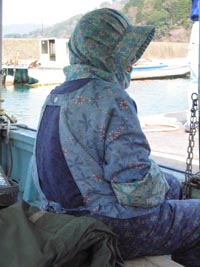 This morning a Monaco-type drive over a lakeshore distance we thought would take an hour-- Okijima always unreachable in the far offing from our house windows, had grown so far away in our minds-- the last stretch, 6 twisting kilometers beyond the little village where 808-step-stairway Chomei-ji Temple is located (and where I used to buy the great traditional black cinnamon candies the local grandmas make), along an old and twisting narrow peninsula shore road overhung with long festoons of blooming cherry tree branches, a tunnel of pink cherry blossoms in the early morning sun, we had the pedal to the metal so arrived early at the boat in the forested cove.
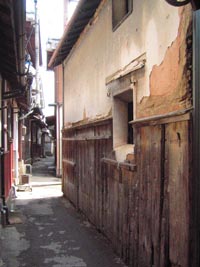 As we walked up and down the alleys and stairways that led to temples and forests, stopping every here and there to look at something of interest, the while hunting for the minshuku (a kind of B&B; there are two on the island), I felt something niggling, something unfamiliar, something slightly irritating, like a pointless gesture repeated endlessly, then I realized what it was: there were no cars or trucks on the island! Not even a motor could be heard! Even in those narrow alleys I had been listening and sensing behind me as we walked, being cautious of approaching vehicles to no point whatsoever; the silence and quietness, the rambling folks and rich air were other clues my deeper mind had noted but my surface mind had overlooked in traveler's distraction. Smiling grandmas cruised by, going to and from their gardens on three-wheelers.
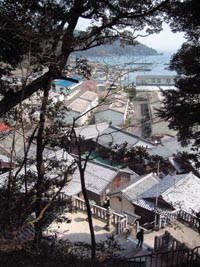 Another thing I noted (and envied) from the casual and open way of the gardens, and as I later confirmed by talking to one elder fisherman sitting on a seawall in the sun making fish traps, the Okijima islanders are blessed with a blissfully complete lack of monkeys. No deer either; their biwa trees and spinach thrive in the freedom sought by all living things. Crows love their cabbage, though; the islanders' scarecrows are old rubber gloves on sticks, rising from the earth among the swelling cabbage-heads like resurrecting gardeners... A bonus of the fisherman's generous conversation is that now I know how to make fish traps.