ISHIYAMA-DERA
Some photos from our recent visit to Ishiyama-dera, one of our favorite local places, posted on before...


 I was standing at the kitchen sink at 6:20 this morning doing the usual - having my tea, looking out the big window into the garden, letting the veil of sleep fade and slowly recovering in greater detail who I was – when I heard a way deep and growing sound , seemed to be coming from the north, then it felt increasingly like I was standing on some kind of foot vibrator as the rumble and vibe intensity increased at high frequency-- then it peaked and faded, the upper timbers of the house gave one big 'crack' as though the house had just uncricked its neck, and all was dawn silent once more.
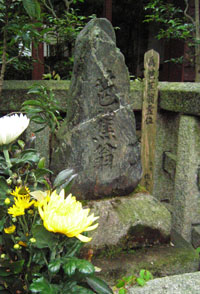 It was no mystery that Basho, at the end of a life spent wandering in pursuit of plain and humble beauty, chose as his resting place this small, quiet temple that perfectly manifests the principle of sabi, its thatched roof the earth-brown color of Basho's robes. It is also no mystery given the view of the Lake this place afforded during Basho's time; he visited here often for poetry gatherings and no doubt steeped himself in its history.
 So there they lie, side by side: the tragic, vainglorious, multiply betrayed warrior and the simple, reclusive wandering poet, in precincts dotted with many haiku-carved stones - placed there by Basho's students and admirers over the centuries - and the grave stone of Kiso's Kyoto mistress over there in the corner (she killed herself upon hearing Kiso had been slain; Kiso's wife was forced to marry into the victorious side of the Minamoto clan, later became a mendicant nun and returned to Nagano in her final days...
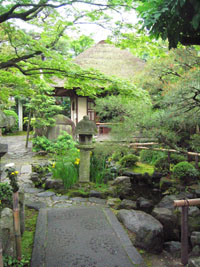 After our visit to Ishiyamadera we went looking for Basho's grave, which I'd been surprised to learn was in Otsu (where Basho spent lot of time) and had since wanted to visit. In our fully intact expedition naivete we didn't need a map, of course; who would need a map to find the small-town grave of Japan's most famous poet and the whole world's haiku master?

 the most seminal western scholar in Japanese history, and recipient of the highest imperial honor ever bestowed upon a foreigner, among his countless other honors and accomplishments. And here he was resting almost a century now in this very quiet and apparently little-known place. The man was a hero in my own past; countless times I had seen his name in just about everything I'd ever read about Japanese culture. Indeed, part of my reason for being in Japan could be traced back to him and his work. Among many others he influenced Hearn, Pound, Yeats, all the way up to Rexroth, Ginsberg, Kerouac, Snyder in our own day, the list lengthens and widens and his influence goes on. Yet with all my time in Japan I never even knew he was here, at this now declining and unvisited temple that he loved for its beautiful view.
 (He had become a Tendai Buddhist at this temple (imagine the radicalness of that in Victorian times!!), and spent much time here.