Friday, March 31, 2006


MORNING CALLIGRAPHY


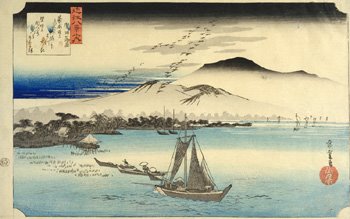
This morning while waiting in the falling snow for the train, which was late due to said snow (a lot of whiteness descended upon us during the night, rendering my left-out motorcycle into a sculpture by Dali), I was gazing into the distance along the quiet gray edge of the Lake, which was barely visible, when I dimly saw coming toward me out of the lacy whiteness a huge black wedge comprised of smaller black wedges, themselves made up of individual black wedges, flapping gracefully. It was the wild geese, heading toward their roosting places around Katata, as famously depicted in Hiroshige's Omi woodcut, Geese Sweeping Down to Katata.

While the inshore wing of the vast flock passed soundlessly only a few feet overhead, the outward wing trailed far back, streaming out low over the quiet gray water, growing thinner and thinner like the firm finishing stroke of a skywide brush-painting of geese heading home, on a parchment white as falling snow.

Wednesday, March 29, 2006

SONGBLOSSOMS

A couple of days of Spring, the plum blossoms just about to pop into clouds of white, and then I'm back out in the falling snow this afternoon, cutting firewood. That's mountain life. But then while carrying in all the firewood and stacking it next to the stove I got my reward: I got to hear the manic warbler over in the thick copse on the other side of the road, doing his beautiful medley (his version of the one Ludwig copied for Pastorale) for as long as his breath held out, the last few notes spaced further and further apart and growing progressively weaker until as I picture it he falls from the branch and lies on the ground gasping for air until he recovers his senses, then he's back up there again on behalf of the leafless trees, serenading the whole snowfalling mountainside. Guess that's how it is when you've been storing up that much song all winter and you just can't wait to give it all you've got, bring some fluid beauty into the still, cold world.

Tuesday, March 28, 2006


TELL ME ABOUT IT


I've been trying to teach Japan to swear for decades now, without any sign of success; it's hard to carry on with a string of internationally colorful epithets when no one understands any of it; the fun all leaks out somehow.

The fine art of swearing is the lifeblood of most societies, especially developed ones, like the US, say, or Italy, France -- Spain has a lot of really good stuff too. But in what would otherwise be the ideal situation for voluminously venomous vituperation, even the best stuff I've got, verbiage that would summon steam from the ears of a New York cabbie (I do my best stuff in NY) or generate a very capable counterflow from a French postal worker, falls flat in the face of the vast fluff of politeness that prevails here in Japan, where no one swears, even for fun.

Tourism Australia seems to have encountered the same problem, though I would have presumed they'd been here long enough to know better; they must have caught a Tokyo rush-hour train at some point in time. Anyway, they unwisely chose to use a couple of pabulum-level swear words in an ad campaign to attract Japanese tourists, but nobody here seems to get it. Apart from the fact that saying such a thing is, well, impolite (I can hear touristic mother-in-laws all over Japan saying, How could one ever make such a basely offensive utterance when inviting an honored guest? Unthinkable!), Tourism Australia seems to be unaware that the swearword vocabulary in Japan remains at the prenatal level, despite my years of effort.

There are, of course in Japan, as everywhere else in the world, any number of private occasions on which a lengthy and well-arranged parade of epithets would be right at home, at least theoretically, as when in my case I'm fighting a tight lugnut or hammering a lot of nails, or when in my garden I kneel on a chestnut burr or find my onions gone and such like moments, when I'm going one-on-one with the cosmos.

In public situations as well, such as at immigration or when I get an elbow in the kidney on a rush-hour train, a spontaneously selected American blend of colorful nouns and suggestive verbs - often with a soupcon of French, a staccato of Italian or some flaming Spanish (I even have some good Turkish stuff) - does the pressured spleen a world of good, but even in social settings here my swearing is purely unilateral; thus, half the effect, indeed the far more important half, is missing. This is even true with the large databank of gestures I bring individually to bear as appropriate; the other party just looks at me with puzzlement. No fun at all. So I've pretty much given up swearing in public here (excepting reflexive monosyllabics), I mean, what's the point, if no one is offended.

Hell, you'd think an organization like Tourism Australia would know better by now; they have a bloody Embassy here, for #$%&!sake!


In radical contrast...

Monday, March 27, 2006


CROW GUSTIBUS NON DISPUTANDUM EST


Finally, in this beautiful weather, got to go out into the garden and get my hands dirty, get some earth under my fingernails, and there found some sneaky depredation I hadn't spotted from the kitchen window.

Nor had I really looked, for it had never dawned on me that any bird would have a fetishy thing for dried and bagged fish meal. I'd left the bag out of the weather under the overturned wheelbarrow, and when I went to take the covering off my brussels sprouts found that I was standing in fish meal.

It was so deep that it covered my garlic, which had been nibbled steadily through the winter by the gourmet deer, who apparently enjoy the garlic fronds as a tasty garnish to my loquat tree.

The garlic had been making a comeback now that Spring had afforded the deer a larger a la carte selection, but even so, it was now buried in fish meal. I have no idea whether or not garlic enjoys fish meal in such quantity, though I shall soon find out at the end of this course in gardener education under Professor Nature.

I removed the wheelbarrow and saw that a large and ravenous beak, the unmistakable signature of Dr. Crow, had nipped and slashed and pulled at the bag until there was a large hole in just the right place to enable him to scoop out mounds of the stuff, far more than he could consume. A little forensic investigation told me why.

Clearly his larger plan had been to invite a number of darkly feathered creatures of his close acquaintance, who apparently love to wallow in fish meal the way Scrooge McDuck loves to wallow in money. The caucus members appear to have silently rolled around and flapped themselves silly in fish meal when no one was looking, especially me.

I scooped up as much fish meal as I could (the garlic will be interesting to watch), bagged it securely and put it in the toolshed where beaks of darkness can no longer get at it. They'll just have to find some other way to enjoy themselves at my expense.

Saturday, March 25, 2006


For just these moments
before the plum tree blooms
I can sit on the corner of the deck
with a beer, put my feet up on the rail
and gaze on the blue lake at evening
through all the whitening buds

Friday, March 24, 2006


CENTAUR GENETICS


[Excerpted from my old journal, The Biwa Book]

[Feb 2000] One snowy night last month there was a knock at the door; I opened it and there was a white horse standing there. On closer examination, though, it appeared to be a centaur (the everyday mind isn't really prepared to make such distinctions): no, it was a person wearing a horse mask, a white horse mask, a very realistic white horse mask out there in the snow in the night, and I knew it had to be Keech.

No one else would come up the mountain to our house on a snowy winter night and knock at the door while wearing a white horse mask. The mask came down all the way to spread slightly over his shoulders, completing the illusion of oneness, of centauricity. Knowing Keech I didn't bother to ask why he was wearing a horse mask, because he wouldn't really see the point of such a question. Anyway, he was a horse at the moment.

I had thought that this spontaneous mask-wearing was simply an eccentricity unique to Keech, but then Echo told me that when the monkeys had come to our house and garden one afternoon, she had put on the horse mask and run out into the garden and the road in broad daylight, as if I myself weren't strange enough to the neighbors.

Then the other evening, when Echo came to the station to pick me up in the van because of the snow, there was a white horse sitting in the passenger seat. I had to take the wheel because, although the subject never really comes up, everyone tacitly agrees that horses can't drive.

Now I know it's not Keech; it's genetic.

Thursday, March 23, 2006


IDLE THOUGHTS


This is something you learn best out in the country, where time is measured in sun, moon, stars and the size of leaves, where there are no schedules, streets or 50th floors, no scramble intersections. When you move from the city out into the countryside, further from the need for minutehands and closer to the actual time of day as quietly and naturally registered on your consciousness by the entirety of sky, you begin to acquire the ancient awareness that is inborn in us all and was once lifelong from the start, that you are in charge of your time, as opposed to when you agreed to a salary. The aboriginal employment arrangement is a very different one, one we all yearn to practice -- when we make our million -- when we retire --

But at whatever age, once in the wildflower meadow's thrall we begin to perceive the aboriginal nature of idleness, the Eden of ideas. All of history's great creators were masters of idleness, but they were only idle to the busied eye. They were idle where it matters. One who hasn't mastered the art of idleness has been living secondhand, without a firsthand.

Idleness punctuates the new idler's life, gives it organic pace and pause, imparts perspective on what once was a blur, enables snapshots, moments of assessment and redirection, the creation of a mindmap of the life's path, thus the idler learns of life from the inside, where it's lived and where it happens, rather than from the outside, where it is chronicled by a timeline of arrivals and departures.

It is a blessing now and then to stop mid-task, the way all deep tasks are designed, sit back against a tall tree, the way all tall trees are designed, and let the moment's momentum take its course as you ride the timestream like a twig, letting eternity itself assert your part in it.

When at last you return, you come bearing gifts.

Wednesday, March 22, 2006


CHINA-JAPAN RECONCILIATION BLOG


Here's a great example of how blogs can aid in democratizing international relations.

"In August 2006, the Department of International Relations at Australian National University will host a workshop on reconciliation between Japan and China. Preparatory to the organization of that workshop, we invite you to brainstorm the topic electronically through this blog. The purpose of this blog is to invite discussion and debate about the best ways to encourage reconciliation between China and Japan."

Reconciliation between China and Japan: A Search for Solutions

Tuesday, March 21, 2006


WELCOME TO SPRING!


Here's to full bloom.

Monday, March 20, 2006


PERFUME IN RAIN


If you can imagine the beauty of orchards of bursting-blossom plum trees in a strong Spring rain, each tree carefully pruned and tended, all arrayed on green slopes surrounding an establishment that has been growing cherry and plum trees for many centuries, then you are where we went next.

In the continuing delight of heavy rain (Japan shows another side of its beauty in downpours), after our descent from Tachiki-Kannon we decided to visit a place Echo insisted I had been to, but that I insisted I had never been to, which made it all the more interesting. My memory served me well; I had never been there. Either that or I've forgotten that I have selective amnesia. For some reason, Echo had generously included me in her own memory of visits there.

'There' is Sunainosato [click the index boxes on the left of their page for additional photos], a place of vast, free-access acreage (private property that is both vast and free is rare in Japan) of cherry and plum orchards that has been dedicated to creating Japan's finest traditional sweets since the Edo era, if not longer.

What do cherry and plum blossoms have to do with sweets? The folks at Sunainosato (who all dress in traditional clothing) use the blossoms, leaves and fruits they harvest there for making such traditional Japanese sweets as my favorite, sakuramochi, cherry-blossom-pink rice paste filled with sweetened bean paste (the only form in which I like it, apart from hot taiyaki), wrapped in a slightly salty, fragrant and crunchy cherry leaf. The cherry perfume from the leaf stays on your fingers long after you've eaten the delicate mouthful. In Japan, the appearance of a food is at least as important as the flavor. To me, sakuramochi , with its lingering perfume, epitomizes that quality.

That quality was protomanifest in all the rain-wet tree trunks, stark as black-ink brush strokes in their living, sun-striving angularity. Ordinarily a dull gray, the rows upon rows of trees on this day were lush with wet, their swelling buds a faint pink radiance clouding the green hills around the old style buildings. The buildings themselves are artistically arranged amid well-tended gardens and other orchards, with walking paths leading to all sorts of treasures, not the least of which is the inner sanctum, where all the sweets are on display and the choice is difficult, even for sakuramochi fans.

Needless to say, we bought sakuramochi (a box of three) and savored their taste and perfume to the sound of rain among the quickening trees.

Such are the ingredients of life's miracles.
Sunday, March 19, 2006


IN THE ABSENCE OF THE WHITE DEER


Yesterday despite the rain we went to one of my favorite nearby holy places, Ishiyamadera (where Murasaki Shikibu stayed for a while and wrote part of Genji), to see if the famed plum blossoms were out. They weren't, so we postponed the plum-blossom visit for another week and decided instead to travel a bit further along the Seto River, a very impressive jade-green burly rush that shoulders itself from Lake Biwa to the sea, providing water to Kyoto and Osaka and all towns in between.

We were headed for the place where Kobo Daishi (aka Kukai) stood at the Seto riverside 1100 years or so ago and saw a strange light shining up on the mountain. Just as he decided to go up there and investigate, a white deer appeared and offered to transport him to the place. Up he went, and there founded the small temple Tachiki-Kannon, where there is now a statue of Kobo Daishi riding a deer and where a famous 12-headed Kannon now resides.

When we got to the very same starting spot though, and stood by the river looking up the steep mountainside, no white deer appeared. Rather there were 700 high stone steps to bear us up to the tree-shrouded top, with conveniently shrined stopping places along the switchbacks where gasping pilgrims both younger and elder can pause and pay their breathtaking respects to the holiness that got them this far and pray for the fortitude to continue.

When at last we got to the top we were in pretty good shape for a couple of elders, though parched from gasping, so we went right away to get out of the rain and have some of the free tea that has been on offer there for just that reason for over a thousand years, then sat and sipped beside the big bronze tea-water cauldron in the small open-sided tea space and viewed the temple precincts. It was very like traveling back in time.

Because it is rather confined in size and sort of out of the way, and because there are 700 steps up to it, Tachiki-Kannon is not much visited in comparison to Ishiyamadera (there were maybe a dozen visitors when we were there), so change is slow. And since time is change, it was interesting in detail. I love places (and people) that truly honor their own age. Definitely worth the trip.

Heading back down the steep steps was a lot easier, like life when you get past 40.

When I get my breath back I'll tell you about the great place we went next.

Saturday, March 18, 2006


STILL HOPING THEY'RE WRONG...


But a US public and private debt 18 times this year's Federal Budget?

"Nine indicators prove that the crisis is unfolding:
Nine indicators developed in this month's GlobalEurope Anticipation Bulletin No 3, which I coordinated, out of which 5 are presented in this public communication, enable LEAP/E2020 to confirm the beginning of a global systemic crisis by the end of March 2006. The recent international trends that particularly affect the international financial system, and the preoccupying trends in the US, namely as concerns the reliability of statistics on the US economy, have brought our research team to conclude that this global systemic crisis is already unfolding....

M3 is really the decisive indicator
As illustrated by most of the 5 indicators developed in the present communication, the last weeks have confirmed how decisive is the US Federal Reserve's decision to stop to publish M3 on March 23, 2006. LEAP/E2020 is now convinced that this decision anticipates a period of acceleration of money-printing by the US, concealed behind public declarations of inflation handling, that will result in the collapse of the US Dollar and in the monetarisation of the US debt (public and private), which a growing number of US experts now estimate that it will never be reimbursed considering its gigantic amount in constant growth (the US public debt now represents more than 8,000 billions dollars, i.e. about 4 times the federal budget in 2006). According to the very conservative Heritage Foundation, if we take in consideration the consequences on the budget of recent decisions made by the Bush Administration regarding health and pensions, the real debt is of 42,000 billions dollars, i.e. 18 times this year's federal budget, and 3 1/2 times the US GDP in 2005."

Japan seems to agree...

Looks like it might be time to get out of dollars...

Whole story in Newropeans Magazine

And a straw for the camel's back....

Friday, March 17, 2006


ERIN GO BRAGH, FAR EAST


All you folks who reside in countries where calendars are not in kanji and have March 17 marked in green with a little shamrock or a leprechaun, and where people come to the office wearing green ties or ribbons even if they're not Irish, well after work today you can just go have a green beer or two for a guy named Brady, grandmothers nee Kelly and McTeague.

ONCE UPON A DEBT...

"Farmer Chang only grows oranges. Farmer Jones only grows apples. Each grows only the fruit that he produces most efficiently, trading the surplus for the fruit grown by the other. Both farmers benefit from comparative advantage and free trade. The sole reason that Farmer Chang 'exports' oranges is to 'import' apples, and vice-versa.

Suppose that one year a frost wipes out farmer Jones' apple crop. Not having any fruit to trade, but hungry nevertheless, he proposes to trade apple IOUs for farmer Chang's oranges. Since Farmer Chang cannot eat all of the oranges he grew anyway, and since farmer Jones' IOUs will pay 10% interest (in extra apples of course) he agrees.

Farmer Chang only accepts farmer Jones' offer because of the apples that Farmer Jones' IOUs promise to pay. By themselves, the IOUs have no intrinsic value. Farmer Chang cannot eat them. It is only the promise to pay apples that gives them value."

And what happens next is about to unfold.

A Tale of Two Farmers

Thursday, March 16, 2006


THE SILENT MOUSE FROM AKIHABARA


I have worked in Japanese offices for decades now, even back when everything was edited by hand and then typed, and retyped... The continuously clacking cacophony of typewriter keys could be deafening on a busy day. Office noise has shrunk since then, and now we are reduced to mouseclicks, but even those... Help is at hand, however, and of course the welcome silence of space comes first from Sanko of Japan...

Did somebody drop a pin?

FUTURE NURTURE


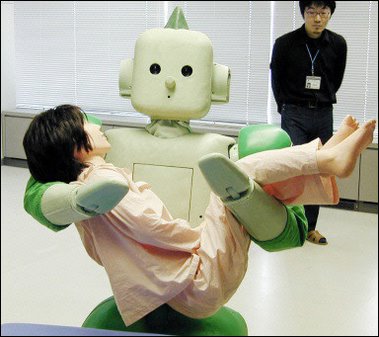
The RI-MAN robot carries a life-sized doll at the Riken laboratory in Nagoya, central Japan. RI-MAN is a seeing, hearing and smelling robot that can carry human beings and is aimed at helping care for the country's growing number of elderly.

Thanks, but I'll just crawl on outta here...

Wednesday, March 15, 2006


THE BIG CREAM PIE OF COMPLACENCY

Early this morning I was tooling smoothly on my motorcycle along the lakeside road through the Spring sunshine, not a care in the world, my mission being to close the final chapter on a dental assignment known subjectively as The Molar Crown Affair. Everything was mission-perfect, as it so seldom is. What with the blue sky, the morning sun, the crisp air, the nearly completed dental work, I felt more complacent than I'd felt in weeks. I probably had the same look on my face that Donald Duck had in that old cartoon just before his house broke in half.

So in retrospect it was definitely time for something to happen, like for the motorcycle to begin feeling funny, as though the road was turning into large regular lumps of tapioca. I shimmied to a stop and saw that the rear tire was flat as a puddle. Road too narrow, no way I could leave the bike there, so I rode it the rest of the way, sort of like riding a fat elephant on Prozac, through the small villages and past the roadside bystanders that always line the way of post-complacency events. Thus it was that I became a memorable form of entertainment for what otherwise would have been just another same-old morning for the lakeside folks.

But this little rumination turns out not to be about a flat tire, but about complacency, the state prodromal to the big cream pie of events. One minute you're anywhere on cloud 5 through 9 and then it's up your nose, coming out your ears and sliding down your face, you're wiping it out of your eyes, yet you never take complacency as a warning, because it's as comfy as a warm fire and a glass of wine with friends; that's why you don't suddenly look over your shoulder or get more insurance or start flashing your SOS or at least run for your life, because what could be better than this? And before you know it you've got that flat tire or your house is broken in half or you've elected an incompetent to national office. The sky's the limit, really.

But a flat tire is nothing in the big garage of happenstance. So in my minor post-complacency reality I slithered and bounced and shuddered my way along all over the narrow road, having to pull to the side if a car came, since I really couldn't do much directional fine-tuning. It was interesting in its way, as was the visit to the dentist and the long walk home, wearing my new crown. Like I often say when I'm complacent, there is good in all things. By the time I got out of the dentist's chair I'd gotten rid of the complacency, which was good, because when I got home my house was still intact.

Tuesday, March 14, 2006


SPEAKING OF CAREERS...


If you're looking for work at whatever age, either via the net or with a change in venue...

"Hiroshi Okuda, chairman of the influential Japan Business Federation, said Monday Japan should accept foreign laborers 'in all business categories' to cope with a shortage of labor in the near future.

As Japan's labor population will begin to decrease by 1 million a year after 2010 [emphasis mine], it will be difficult to overcome a resultant labor shortage only with the addition of more senior citizens and women to the labor force and the utilization of information technology, Okuda said in reference to the need to aggressively accept workers from abroad."

Story

Monday, March 13, 2006


MONKEYS AND CAREERS


As it turned out, we safely beat the monkeys home; they were delayed by some large tangerines a farmer had discarded onto his rice paddy, where the marauders hung around for a goodly while, peeling and eating and scurrying off with armfuls of orange fruit to eat in private where no one else would get any.

It being a fine day, with rain coming tomorrow, now was the time to clean out the long overdue raingutters. So an hour or so later, there I was up on the stepladder with a hand in a downspout when I heard an odd sound behind me, like an upset simian adolescent. But how could this be, when I was physically present in my garden? Turning my head around as best I could, I beheld there atop my herringbone layout of shiitake logs a large male monkey who had quietly crept into the garden while my back was to it, he knowing full well that although I was present, I was up on a ladder and so no immediate threat.

If I had stepped out of my doorway, he'd have been off like a shot. But he knew what ladders were, and the little that humans could do atop them. He kept his eyes on me full time while both of his hands felt the logs for fat shiitake. A few meters behind him squatted an adolescent monkey, the one who had given the game away by being unable to stifle his complaint at being stiffed out of a whole show window of savory shiitake by the big bully. The look on his face was much like my look when I was 15 and really, really wanted that Corvette. The teenage monkey was paying no attention to me, since he knew that the big guy was taking care of that; he just eyed the big fat shiitake with very forlorn eyes.

Like an expert simian I hissed at the thief from atop the ladder. Like an even more expert simian, he put a big shiitake in his mouth and grabbed another. I started down the ladder. He put another shiitake in his mouth (they use it like a briefcase) and groped around beneath the logs where the fattest shiitake were. Off the ladder now and more simian than ever, I raced toward him, looking as big as possible. He had no time to grab another mushroom; I grabbed a rock and heaved it. He disappeared into the forest across the road. He had dropped a fat mushroom, which I pocketed. I also harvested the rest of the remaining mature ones, though clearly the monkeys had gotten most of the biggies.

I had been checking the shiitake every day I'd been home for the past couple of weeks, and no more than buds had emerged. Then I'm away for two days, don't check them for just one morning and whooom! they all come out at once to the max during one night, just in time for the winter-hungry monkeys. Makes you wonder whether it's better to have a career or just lope through the forest.

Saturday, March 11, 2006


THE BOB AND ECHO SHOW


Today when Echo and I were taking a Spring morning walk, we cut across the cascade of paddy terraces and took the road down through the forest on the other side. We'd gone about 20 meters when I saw a young monkey cut across the road ahead of us and then another; then some elders followed, drifting in the general direction of our garden, which always comes to mind when monkeys are around.

When we got down to the place where the dastardly marauders had crossed, we noticed that quite a few of them had gotten across and were hanging around in the trees waiting; on the other side of the road there were still a goodly bunch of the redfaced vandals who couldn't get across till we went by, so they were just sitting there on a bunch of logs, well into the forest, watching the Bob and Echo show on their version of tv.

Since that audience was closer to us, Echo pegged a rock at them but they didn't flinch an inch, since it landed about 30 meters before it reached them. She did the same again. The monkeys did the same again. I said to Echo 'They know it's a woman throwing so they're not intimidated.' Whereupon on behalf of men everywhere I picked up a rock and threw it at the pillaging denizens; it landed about 30 meters in front of them. I haven't thrown a rock in quite a while, I'm way out of practice, only a couple of snowballs all winter, there haven't been any monkeys around for a long time and so forth.

Anyway the shaggy visigoths (no offense intended to human Visigoths, who were eminently noble in their way and, as placation from the Roman Empire they had recently sacked, were privileged to occupy that part of Spain where my daughter was born) found this all mildly amusing; they looked at each other and gave that sort of anticipatory snicker often heard in human living rooms in the first few minutes of prime time. We did our best, but the Bob and Echo Show only managed to last a couple more minutes until the unscrupled simians lost interest or went off to get a snack and we were cancelled, with likely reruns and no residuals.

After we had walked further enough down the road, the rest of the massed marauders loped across and joined their fellows, still drifting in the general direction of our garden. I figured we'd better get home before they did, since the new shiitake are just coming out, so we hastened on in parallel with the path of the feral vagrants.

To be continued with what later happened in that regard...

Thursday, March 09, 2006


PROGRESSIVE SIMPLICITY


Critics of the modern often seem to forget that all the people who over the centuries turned away from the hardscrabble life of primitivity did so by choice. They looked at the raw-knuckle living they'd lived all their lives, the early deaths of their forebears, and they preferred the kid gloves, the down mattress, the lighted room; they preferred ease, a bit of luxury, a bit of style, a bit of rest, easy warmth, varied food, both hot and cold, and floors beyond dirt, with more and more distractions from a reality that relentlessly required direct and often dangerous participation; and who can blame them? Who does not prefer relative ease, after generations of fingerbone toil? That is the very premise of fat. To those who live on the bottom line, fat has always been the standard of beauty.

And now, over the century since we in the developed world left the dirt floor for the vinyl - if not marble - corridors, we have romanticized that often dark, cold, dangerous and thankless lifetoil into an idyllic little-house-on-the-prairie existence, when in fact it was common then to have most of one's 12 children die before puberty (one reason why there were 12 children), or as an adult to die of a shaving cut; anorexia is now the wealthy, civilized standard of beauty.

Convenience and well-being, like trash, have become relative. A PET bottle is an invisible convenience to us while it has content, and distasteful trash to us thereafter, but if you could go back in time and show it to a primitive man, he would grab it from your hands and trade for it his own finely decorated gourd, and for good reason; it is transparent, it is strong, it is light; but perhaps most importantly of all, it is new, and in its way, astonishing.

Steel over stone. Fat over bone. Excess over lack. That has always been the natural human aspiration. This has led to mistakes, which is human nature too, but retrogression is not human in nature. The solution is improvement, as it always has been. And the simpler the improvement, the better. Simplified progress. Progressive simplicity. As there is no need for us to lie stagnant in the dark and get lost in tv, there is no need for us to live in the dark and eat roots with the dirt still on to achieve that purity that naturally obsesses us. Our true way of being lies always in the future, not in the past.