Saturday, October 15, 2005


THE ORGANIC CROPS OF FARMER JOHN

A brief but seminal interview with John Peterson, organic farmer and star of The Real Dirt on Farmer John, an award-winning documentary film about the challenges confronting small farmers in the United States. His Angelic Farms is now one of the most successful Consumer Supported Agriculture (CSA) farms in the country. Wish they had the equivalent in Japan.

More about Biodynamic Agriculture

A GREAT IDEA!


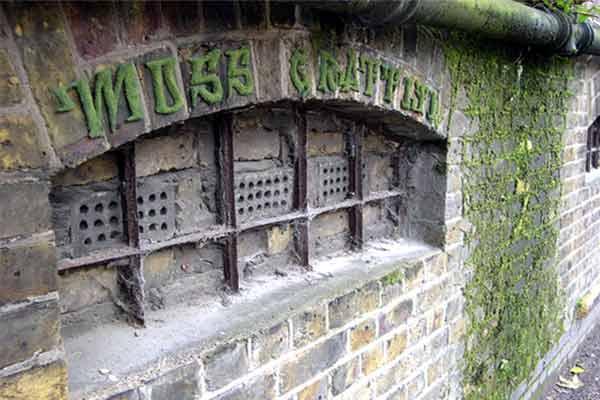
MOSS GRAFFITI

w/thanks to Anna at SelfWinding

Friday, October 14, 2005


SAVE ENERGY (AND MONEY) THIS WINTER


Download the European Union's

GREEN PAPER on Energy Efficiency or Doing More With Less

At least some folks in authority are paying genuine attention.

THE ATOMIC CAFE


Democrats Abroad Japan will screen The Atomic Cafe on Monday, October 24 at the Blarney Stone Irish pub in Umeda, Osaka, along with some related video clips on recent nuclear developments and revelations.

Thursday, October 13, 2005


4000-YEAR-OLD HOLY RELIC FOUND


WORDS FROM GRANNY D


"Where authority and power flow down from above, from heaven to the White House to husbands and ayatollahs, the free and joyful living of people can be quite the enemy. If you will remember the free spirit of those flower children who grew up in the 1960s, for example, you will also remember the harsh attitude that attended to their joys from the more traditional, often more rural, elements of our society. Those political leaders who rose from this time, who lived in this more open and free way--less constrained by the rules of authority--were especially vilified by the authority clan. You need only to think of the special treatment given to the Clintons, who were of this generation and climate, to know the truth of this. And it fits the international pattern, of course, that the woman, Mrs. Clinton, would be singled out for the cruelest stones.

What attracted such hatred? It was their freedom, their sense of equality, and their joys.

Here it is: those in the clan of authority are not given the privilege--the natural right--of living their own lives. They do as they are told, say and think what they are told. Smothered is their curiosity and their healthy skepticism, and also their imagination, joy, freedom, and lust for life itself. When they see others actually living lives, they react with anger, as if someone had cut to the front of a line that, for them, never moves.

What is the proof of this theory? Those in thrall to authority, cowering under it, lose sight of their own lives. They will venerate above all else the symbol of the yet unruined potential of life: the curled-up unborn. The authority clan will have the image of an unborn baby as its flag, and they will claim to honor and defend innocent life, but that will be a great lie to themselves. For they will not be the ones to demand DNA testing of all prisoners on death row; they will not be the ones to demand health insurance for all children, or better nutrition in all schools, or peaceful alternatives to international conflicts. They will be the ones to rail against these things, for the authority clan parades itself as pro-life while it is truly more like a cult of death. Having died themselves, strangled by authority and fear, they cannot wish happy lives for others--they cling only to that magic symbol of what might have been. They relate to the unborn baby selfishly; it is themselves: unborn, unlived, still hoping for a life."

Excerpted from We Are Resolved to Follow Our National Dream, a speech given by Doris 'Granny D' Haddock at Orchard House, Home of the Alcotts, in Concord, Massachusetts on October 6, 2005.

Read the full speech

Granny D on NPRadio

w/thanks to Ken

WHAT TO DO ON REALLY, REALLY RAINY DAYS


There's not all that much to love about really really rainy days unless you're a droughty farmer or rainmaker, but we're neither, yet we love rainy days, get lots of them and we're not ducks. One of the things we love about double-r rainy days is that they afford the ideal opportunity to visit one of the big temples around here that are at their very best in the wetness and light of rainfall, not least because there are far fewer rainy day visitors to venues that generally can be more of a massive sardine experience.

That's what we did on Saturday, when it was raining so hard that walking down the street was like spalshing through water, pants wet up to the knees. I'd just planted winter spinach on Wednesday, so I was happy on that account too (gardening gives you a lot of extra things to be happy about, which fact can also come in handy on double-r rainy days).

So we went over the mountain to visit historic Sanzen-in, the anciently renowned and moss-gardened temple in Ohara, just outside Kyoto. The fact that it was on a Saturday and the visitor count was about 20% of usual made the whole experience even more of a miracle.

Walking up to the temple in the rain that brings out all the green in the leaves and the many colors in the stone walls - with all the pathside shops and their wares glowing into the outer dimness - climbing the stone steps and entering the incense fragrance of the temple building where golden Buddhas glow in dim recesses, while out on the long veranda, where all the shutters are lifted, gleam the many shades of emerald that are the garden beyond the pond, the moss, pines and maples, the stones and stone lanterns, all hissing softly in the rain like a faraway chanting, all you can do is fall silent, be seated on the straw mats and meditate on living the link between beauty and sanctity.


The little Buddha I photographed in his secret place in the greater garden knows this too; his face says so.

Wednesday, October 12, 2005


DRAGONFLY DESIRE


Early this morning I headed down the road to near where the wild pigs have their doorway in the new bamboo, left the sunlight and plunged into the spiky shadows to cut a bunch of tall stalks for arching over the new spinach and covering with netting to keep crows off the sprouts and deer off the full leaves.

I had cut about a dozen stalks and was carrying them on my shoulder in a long clacking bundle when a red dragonfly, redness dimmed to near rust now that he was in the waning portion of his courting days, began hovering along the bamboo I was carrying. Male red dragonflies live to position themselves prominently (especially atop bamboo, around here) so as to best display their extremely seductive redness to best advantage among the flitting dragonfly ladies, and here was the only bamboo in the road, so he had elected to land and pose upon it.

Trouble was, for the first time in his entire summer life, the very spot he sought to claim was not swaying in the wind, as he was used to. Though it was bamboo, it was horizontal and moving steadily along in one direction. These new phenomena in his universe, however, gave no pause to his desire. He had his eye on that courting spot, and would not give it up.

Thus it was that I walked up the long road toward the house with a big red dragonfly beside me, he floating along in a fixed place, aiming the while at the point of his desire, that stayed just out of reach despite his obedience to history.

As to my own desires, I can’t count the times in my life I’ve done exactly the same thing, without bamboo.

Tuesday, October 11, 2005


THE JAPANESE ORGANIC PRODUCT STANDARD
or
You Call That Organic?

In response to a question posed by Tabor in a comment to an earlier post of mine, here are the basic principles of the Japanese standard for organic agricultural products, as of 2001:

“(1) To sustain and enhance the natural recycling in agriculture, the productivity of
the farmland derived from the soil properties shall be generated by avoiding the
usage of the chemical synthetic fertilizer and agricultural chemicals, and the
organic agricultural products shall be produced in fields adopting such
cultivation management method as reducing the load derived from the
agricultural production on the environment as much as possible.

(2) In collection fields (meaning the field for collecting the agricultural products
growing spontaneously; being the same hereafter), to collect the agricultural
products by such methods as affecting no damage for preserving the ecosystem
of the collection fields.”

The major loophole here of course, which you could drive an agribusiness chemical plant through, is “as much as possible.” Though it would be exceedingly difficult, maybe impossible, to derive an organic standard that's fully satisfactory to all parties, surely Japan can do better than this. It is a start at least, but a poor one.

Here is the pdf for the full Japanese Organic Standard. (9 pages)

Free downloadable reference book containing 6 international organic standards (US, European, Japanese, Quebec, Swiss, and IFOAM)

Monday, October 10, 2005


THE SANDBAGGER


I don’t have a dog, and am not thinking of getting one, but many folks around here have dogs - the dogs are happy in the mountains - and in my walks I see dogs here and there in the towns, most recently on a walk we took in Ohara over the mountain, where we passed a middle-aged Labrador retriever lying stoneskull bored on the concrete doorstep of his owner’s home, his leash tied to the veranda post.

He watched us walk by coming and going (some action at last!) and each time raised his head to look as we spoke to him - and he listened - his attentive eyes showing no hostility, no threat to bark or lunge, he was an especially intelligent dog, bred to run in wild fields and plunge into waters to retrieve hunted birds softly in his mouth, pleased to help, action and knowledge bred into every cell and sinew of his body, and he just laid there bored to death, getting fat, most probably never retrieved a bird in his life, never did at all what he was bred to do…

Seeing him I was reminded of a born-to-run Irish setter near where we used to live in Kyoto, that spent all his each and every dismal day in a cage not much bigger than he was, barely enough to turn around in, and when we’d walk by he wouldn’t even raise his majestic red head, just roll his eyes up to us as if to say shoot me now, his hunting life and marathon breeding more unfulfilled than a samurai salariman in charge of rubber stamps.

We’d stop and talk to the setter and pet him, but it was painful to kneel there and reach through the bars imagining all that beauty running free. When I saw that Lab retriever tied to the post where he was spending all his waking (and likely sleeping) life, it occurred to me that dog owners should be strictly licensed to own certain breeds of dogs, and be required to use the dogs only in the activities (or suitable equivalents) for which they were bred.

As a corollary it occurred to me that maybe a new breed is advisable, a dog bred solely for lying in cages or tied to the veranda post all day doing nothing whatsoever, that I would name the Sandbagger, a full-fledged canine with no ambition other than eating and repose, his life fulfilled to the utmost by complete inactivity, carefully bred for the cage and any form of strict confinement his lifeless masters could think up: he’d just love it, maybe on rare occasions wag his tail at very low frequency to indicate that he was still alive, which would be about all such owners need in their pet.

Sunday, October 09, 2005

Saturday, October 08, 2005


ENGYOJI


Finally I can get a word in edgewise here, and relate our last-Saturday visit to Engyoji temple complex on Shoshazan (Mt. Shosha) in Himeji. Our specific reason for going was to enjoy a shojinryori meal at Myoko-in, a small old building in the complex that serves the traditional meal in a formal setting. There are also places where visitors can stay overnight in the temple buildings, but we only went for the day. It was a longer trip than I’d expected from where we live. Took a few train hours to get there, then a bus ride to the mountain, then a brief cable car ride.

Shoshazan is the western counterpart of Hieizan (Mt. Hiei, our neighbor mountain), which guards Kyoto to the north and is home to the temple complex Enryakuji).

The temple complex and pathways were soulfood as always, but the point of this post is a visual of the meal, which was served at individual tables in a large garden-sided tatami room, some in a basket and some on a very large lotus leaf. Eat your heart out, Michelin...


Friday, October 07, 2005


ON STARING AT MONKEYS


In re the previous post, I should point out - so as to forestall any unexpected monkey-human hostility - that in monkey society (at least Japanese macaque society) it is impolite to stare directly, particularly at alpha males, to whom staring is a direct challenge sometimes requiring physical resolution, much as in certain sectors of human society (we’re not all THAT far apart). Thus monkeys don’t really stare, in the human sense, nor was I staring at the monkey in the human sense. We were staring at each other in the monkey sense, comprising quick glimpses and quick lookaways, which, though quite natural when staring at monkeys, oddly enough is considered shifty-eyed in human society. Thus when I got on the train I had to remember immediately to stop staring like a monkey.

Thursday, October 06, 2005


THE MONKEY AT THE END OF THE TUNNEL


Setting out early this sunny morning to freewheel down the mountain to the train station on my motorcycle, I’d gotten up to a good speed as I approached the tunnel under the road when I spotted at the other end of the tunnel a middle-aged monkey just sitting there solo in the middle of my road doing nothing, not scratching, not even eating somebody’s onion, just staring nonchalantly at that big hole with the dark speck inside, increasing in size and noise, that was me.

I revved my engine. He stared. Beeped my horn. He stared. Then I emerged from the dark of the tunnel and he realized I wasn’t part of the big hole, leaped for a utility pole support cable by the roadside and hung there staring, suspended as comfortably as we sit in armchairs watching tv. I wasn’t in an actual hurry myself, really, just one of those artificial hurries I get into when taking advantage of the free gravity, so I pulled to a stop beside him and sat there idling. We stared at each other for a while and thought about things, like a couple of reasonable simians.

He hung there staring casually at my chromy bike, my boots and jeans, my brown shirt and black baseball hat, my orange knapsack and surfer shades, the tilt of his head reflecting a remote wonder at why I needed all this parpaphernalia compared to his trim and time-tested fur coat, low unhatted brow, bright red face, unshaded auburn eyes, all you need for living a good life on no salary. The one trait we had fully in common was the lack of a tail, for some reason to do with shared evolutionary fashion.

He’d obviously been doing well in the forage department, his heft likely due in no small part to some of my missing Roma tomatoes. After I left for my office in the city he’d no doubt get back to work himself, visit my garden for a few fresh homegrowns, then climb into the trees and nibble on a variety of wild fruit and nuts, wash it all down with fresh sparkling mountain water like we can buy in the convenience store, before finding a nice tall breeze-rocked oak to take a nap in.

Just about then my full-time office appeal index fell below zero; but I’m nothing, if not human, so I broke off our little interspecies exchange, left him hanging there and rolled on down to catch the train. In his own way, I'll bet the monkey did the same.

As to the ultimate value of human intelligence, the jury’s still out.

Wednesday, October 05, 2005


PURE LAND MOUNTAIN PHOTOS


In the 3-plus years I've been doing PLM so far, I've posted a lot of my photos in text and sidebar. I've now begun slowly compiling them into a publicly accessible file on Flickr (hence that untowardly throbbing badge over there on the left). But I have a problem with it that maybe one of you CSS experts out there can help me resolve. If I put the badge where I want it, i.e., below the regular Shiga Window photo, everything between it and the photo of me at the top disappears and the badge is where you see it now, but with all that should be above it no longer visible; any way to resolve this? Till resolution, I'll keep it where it is now so that all else remains visible and folks can access the photos if they so desire. Hope you enjoy them.

Tuesday, October 04, 2005


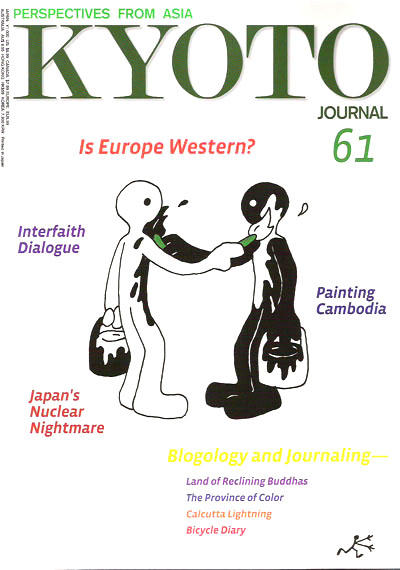
KYOTO JOURNAL #61


NOW OUT!

Monday, October 03, 2005


DIAMOND SEED


Early this morning Echo and I went down to the village rice polisher to polish 30kg of organic rice from Moriyama to send to Kasumi (Kaya and M&M go through rice like sumo wrestlers). When we got there a rice farmer was just opening the shed and was about to polish some of his own rice, but graciously allowed us to go first. As we were chatting, another farmer came to polish his rice, then another. Even at that hour the rice polisher was action central, all the rice having just been harvested.

At any rate, we finally got started, pouring the rice into the hopper, setting the polisher for pretty fairly darkly brown rice, making sure to catch the bran for use on the garden. As we and the farmers then stood there tweaking the polisher and waiting, Echo happened to mention that we were polishing completely organic rice from Moriyama, which was sort of like bringing out a handful of Hope diamonds at a gem convention.

All the farmers, multi-generation rice experts to a man, clustered up to the machine to eye the rice, grab a handful of grains from the hopper and take it out into the sun, where, under the farmer’s light they shifted and turned the grains in their brown farmerhands, eying the kernels as if they were holding handfuls of diamondseed, talking to and among themselves, looking for something, then saying to us that if this is organic, where are the signs of insects? There are always signs of insects with organic rice, but there are no signs of insects in this rice, are you sure it's organic? They showed us handfuls of their own rice, as if we too were experts.

We assured them that the grower had a special technique involving some natural material he had developed that bugs didn’t like, and avowed it to be 100% organic; the farmers collectively agreed that it must be true then, since no rice farmer would ever lie about his rice, a rice farmer would have too much integrity to do such a thing, it’s unthinkable, how much do you pay for it and when Echo told them they all fainted slightly, the price being about double what they get for their non-organic rice, and I’m sure it got them thinking further along positive lines...

But seeing that collective trust for a nameless stranger who wasn’t even present was every bit as nourishing as the brown rice will be...


Sunday, October 02, 2005

THE MURDERS IN BALI OF FOLKS SIMPLY ENJOYING THEMSELVES

reminded me of an essay by Richard Dawkins:

"I was prompted to write this article by the smiling face of a very happy man in Bali... He was ecstatically greeting the news that he was to be executed by firing squad for the brutal murder of large numbers of innocent holidaymakers whom he had never met. Some people in the court were shocked at his lack of remorse. But far from remorseful, his mood was one of obvious exhilaration. He punched the air, delirious with joy that he was to be "martyred," to use the jargon of his particular sub-culture of Gerin oil substance-abusers. For, make no mistake about it, this beatific smile, looking forward with unalloyed pleasure to the firing squad, is the smile of a junkie. Here we have the archetypal mainliner, doped up with hard, unrefined, unadulterated, high-octane Gerin oil."

From Opiate of the masses
"It is a highly addictive drug, but governments everywhere encourage its use"

Richard Dawkins

Saturday, October 01, 2005


FAMED OSAKA CONCOURSE TO BE DESTROYED BY HANKYU

We all know how insensitive big business can be, especially when it comes to beauty in public. That seems to be particularly true in Japan, where the taste of bureaucrats and executives who can't even choose their own neckties determines how whole cities look. Take for example what they're doing to once elegant Kyoto, whose new train station has acquired the nickname “Stalin’s Headquarters.” Beautiful.

Speaking of beauty, Osaka had a lot less going for it in the looks department than Kyoto, having been almost completely destroyed in the war, and postwar cram-rebuilt by businessmen and bureaucrats into the ugly duckling of Japan's large cities, so you'd think they'd be sensitive about that at every turn, and do something in keeping with all their PR-brochure-chatter about “advancing into the future” and “making the city more attractive to tourists and residents.”

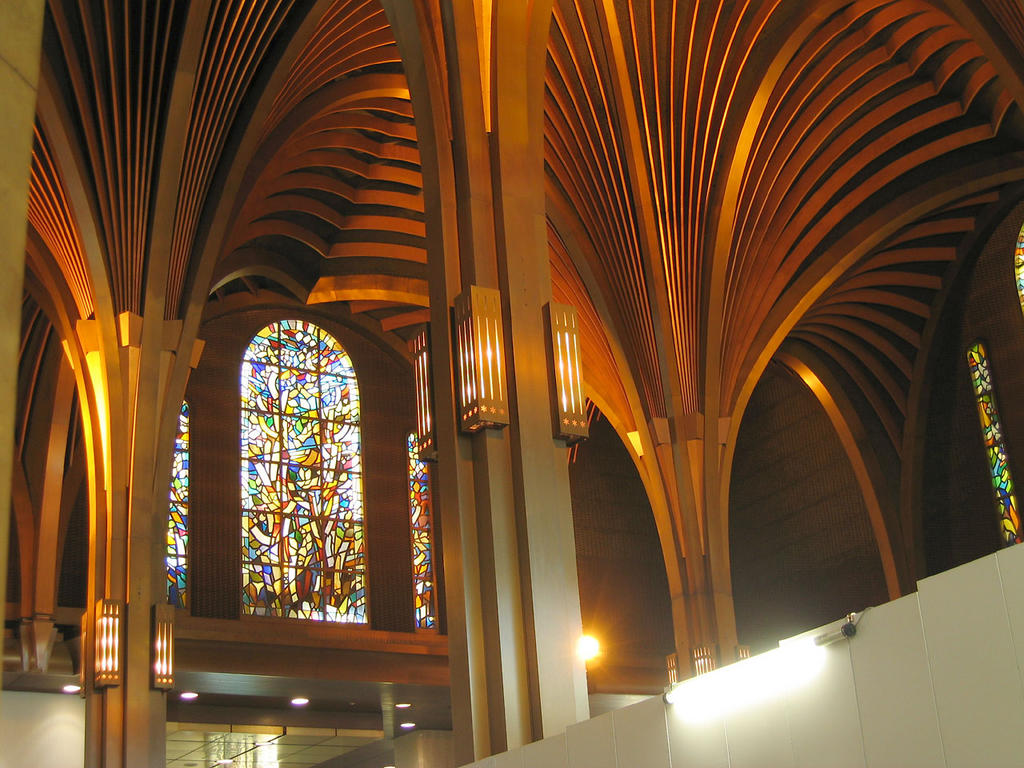
Now word comes that one of the few last bits of architectural splendor to survive the war, the Hankyu Concourse, a long high-ceilinged (in Japan!) arcade built in 1929, with chandeliers, mosaics, stained glass windows (all rarities in Japan, especially from nearly a century ago), the only oasis of genuine ambient beauty amid all the warrens of Osaka's Umeda station (the hub station of the city), is to be destroyed by Hankyu Department Store and Densha businessmen, and replaced with an inexpensive imitation of what profiteers think is beauty, perhaps a la Disney, maybe a double-layered mall of minishops selling Hello Kitty and lesser items behind plasterboard facades with a little recycling fountain that plays relentless songs about the magic of new possessions...

As to the public who in that high, cool, elegant concourse can yet find some aesthetic relief from the general tawdry scrunch, who cares what you want?

(Website dedicated to saving the Hankyu Umeda concourse)(Japanese)
http://blog.livedoor.jp/hankyu13/
With thanks to Ron Andrews