Friday, October 27, 2006


GEISHA HAIR


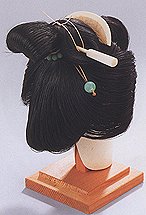
As a result of an earlier post of mine about Japan's only male keppatsu-shi (geisha hairdresser), ever since the Memoirs of a Geisha movie came out I've been getting many hits a day from all over the world searching for "geisha hair," "geisha hairstyles," "geisha combs," "geisha makeup," "geisha hair tools" and all geisha beauty permutations, though nothing about how to become a geisha, the nature of geisha, geisha clothing etc.

The searches seem to relate only to hair and makeup, and seem to be increasing lately for some reason, though the movie came out a year ago and the book some years before that. I don't hear much about either in the media anymore, but apparently a growing number of women out there want to look like a geisha in some way or other, though the only such women I've seen are actual geisha.

Though geisha do put on their own makeup, they don't do their own hair; clearly, that would be impossible with such an awesomely complex tonsorial architecture, involving all its highly specialized tools, materials and accessories. Maiko (apprentice geisha) have hairdressers to do their hair once a week, and sleep on hard, high-rise pillows so as not to mess up their hair between visits to the stylist. After they become geisha they generally wear katsura (wigs).

As to geisha hair accessories, on my strolls through Tokyo's back alleys in the early 70s one of my favorite stops was a tiny shop run by a then very elderly man and his wife, who sold geisha combs and kanzashi (hairpins) of every description, the walls of their small space comprising drawers filled with tsubaki (camellia) oil in which rested all the combs the couple made painstakingly by hand, seated right there on the floor: big, small, long-handled and long-tailed combs, and in a glass case the hand-carved and decorated combs and hairpins. When you bought a comb it was oiled for life. Those items were way too expensive for poor traveler me, but I loved to look at them and talk to the makers, ask them questions. Here is a good site for decorative combs in the traditional manner.

But as yet I see in the media no signs of geisha hair, makeup or accessories in Paris, New York, London, Rio. Wonder what's going on, and who among the modern Western young would want to have to learn to sleep on a geisha pillow every night, so as not to mess their hair? That takes lifelong dedication of an ancient sort...

Thursday, October 26, 2006


AGING AND ELDERS AND BEARS, OH MY!


I myself have never seen a bear around here, though I've heard tales of them in these woods, seen signs of them and know they're there. I know several bear-scratch trees, which are usually near an old oak where the bears get fatted up on acorns for the winter and polish their claws, mark their turf before the big sleep.

I also have a section of a bear tree I found the other day among some firewood I scavenged from upmountain. As I was deciding whether or not the section needed to be split, I spotted five long, last-year gouges in the wood on one side; on the other side was one dark older gouge, made when the tree was younger and since widened by the tree's subsequent growth.

A couple of springs ago, not far from here - down below us, in fact - a farmer was attacked by a bear he'd come upon suddenly while walking home through the woods in the late afternoon after working in his fields. Fortunately he was carrying a hand scythe, and was able to stab at the bear and drive it away before it did too much damage.

The mendicant monks of the mountains (yamabushi) used to (still do?) carry walking staffs with metal heads that had metal rings dangling from them that clinked loudly every time the staff struck the ground along the mountain trails, the sound giving any nearby bears ample warning to get out of the way, as that is bears' preference, if given the chance; if they can hear you coming, you'll never see them. Whistling is good too, which is what I've always done when I walk, and likely why I've never seen a bear around here. Then again, maybe that's a tacit bear comment on my whistling.

But never in my wildest bear ponderings have I come anywhere near making a connection between the current aging of the Japanese population and the increasing number and daring of bears! Bear/human interaction, including raids on gardens and attacks on humans, is definitely on the rise, judging by the number of such incidents I see on the tv news, but I had no idea that increasing human elderhood was a factor!

The fabric of the universe is infinitely woven...

[Later addition: Good bear article, with thanks to Jeff Bryant]

Wednesday, October 25, 2006


SPEAKING OF HEISTS, A MUST-READ FOR BELIEVERS IN DEMOCRACY...


"But the 109th Congress is no mild departure from the norm, no slight deviation in an already-underwhelming history. No, this is nothing less than a historic shift in how our democracy is run. The Republicans who control this Congress are revolutionaries, and they have brought their revolutionary vision for the House and Senate quite unpleasantly to fruition. In the past six years they have castrated the political minority, abdicated their oversight responsibilities mandated by the Constitution, enacted a conscious policy of massive borrowing and unrestrained spending, and installed a host of semipermanent mechanisms for transferring legislative power to commercial interests. They aimed far lower than any other Congress has ever aimed, and they nailed their target."

How they did it, in five easy steps.

Here's hoping for Democracy in November... but can Democracy survive Diebold? (or Hart InterCivic?)
+

Tuesday, October 24, 2006


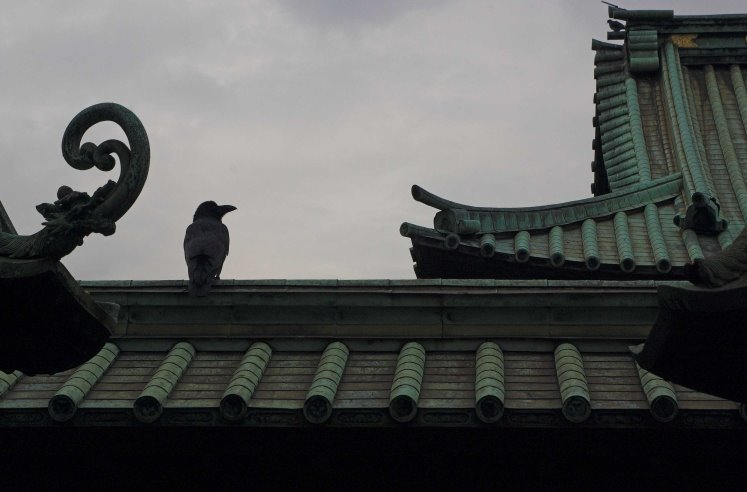
WHEN CROWS CONSPIRE

On a recent sunrise walk through the mountainside maze of little roads that run back and across up and down through the terraced rice paddies, we were crossing a little bridge over one of the many streams that lace the mountainside when I spotted two big crows hunched like a couple of Richard the Thirds on the railing of a small bridge further up the mountain, yakking and clacking in close conversational beakery as they sat only inches apart. Couldn't hear the specifics, but it looked very confidential.

We wandered on along our road, later turning upward, and by chance, about a half hour later wound up coming down the mountain along the very same small road that passed beside that particular bridge, and there, still hunching on the bridgerail in very hush-hush consultation were the same two crows, still intently beak to beak, clucking mysteriously about whatever mysteries crows cluck about, I don't have a crow dictionary, but it looked very much like it had to do with some major heist or other.

They'd had their beaks together for at least a half-hour so far (plus who knows how long before we arrived) and they weren't finished yet. There wasn't another crow anywhere around, it was odd to see those two together for that long at that hour and not looking for breakfast, must have been something of truly corvine importance. We drew closer and closer to them but still they plotted, in lower and lower tones and more and more nervously as we neared; then when we were close enough to begin to overhear they flew off together to a tree further down the same road and did the crow equivalent of "As I was saying..."

And so it went for a few more interruptions as we strolled down the mountain, each time drawing too close for BlackFeather security, until the two dark conspirators got tired of being interrupted and flew off at a huffy right angle into the forest, where they could plan in detail for as long as needed.

One early morning not long after, it appeared that more than one large sharp beak had savaged my just-stacked bags of abura kasu (soy oil cake) fertilizer. I've got to get that dictionary.

Photo via Visueelvenster

Monday, October 23, 2006


SPEAKING OF ALL THESE ANIMALS


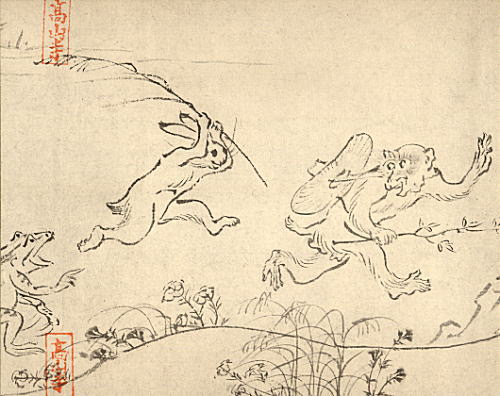
I'm reminded of the Choju Giga Scroll

Housed at Kozanji Temple in Kyoto

Sunday, October 22, 2006


WHAT A BUNCH OF ANIMALS!


Yesterday must have been Animal Day around here. After my experience the previous night with the musical Baron, I was out on the deck early yesterday afternoon sorting firewood into the holder when I spotted a monkey swaggering up the inner road like he owned it, when in fact - at least, de jure - I own it. Well, this half of it. The monkeys just hold some vague unwritten heritage-based title, founded on nothing but eons of actual possession.

I went to the edge of the deck so he could see me and I pegged a monkeyrock to let him know this was my turf and I have a deed made of paper to prove it. He ran on up the hill, and when out of sight and rockshot, gave one long complex screech. He was followed soon after by a lot of monkeys, many lots of monkeys, a mountainside of monkeys, loping past my place on their way upmountain for whatever is happening up there this time of year, perhaps meeting of the 'families,' must be a lot of wild fruits and nuts fully ripe about now, chestnuts, akebi etc., to say nothing of homo sapiens' orchards and gardens along the way. (I later heard the loud clanging of spoons on potbottoms from a distant upmountain neighbor as the ascending horde reached his gardens and vineyards.)

The interesting thing was that after the single complex screech, any monkey who passed my place on the road ran past quickly, even though I was invisible to them until they reached my gateway, plus I was downwind and making no noise. More than half the tribe were just past infancy, many still clinging to their mothers' backs, some of the more courageous little ones running free in curiosity at this vast new world that - according to their parents - was all theirs; they'd stop to look around mischievously and poke into everything, but not one of them passed by on the road or came near my property, apparently aware that in some incomprehensible way I claimed 'possession.' Most of the monkeys - and all of the little ones - traveled past on the newly cleared property across the road.

Somehow they'd all gotten the message. None came even to explore after my vegetables, or just out of curiosity. The message had said "There's a human there and he throws rocks that reach the road, so if you're a grown up on the road, run past there; all others use the farther piece of property where the rocks won't reach." And so they did. In great numbers. There must have been several hundred barrelfuls of monkeys. The whole moving tribe was more than 50 meters wide, reaching all the way to the further inner road; they passed by steadily in groups and solos for about 10 minutes.

Well after sunset, while I was out carefully examining the amazing selection of diamonds that had been strewn randomly on the dark blue velvet overhead, I heard an unusually loud blundering rustle coming from the next property up. I went and got a flashlight and came back out, and there was the Baron, standing in front of my shiitake logs and paying no attention to my presence, sound, smell or light, as though he was distracted. He just stood there. It wasn't like him to blunder, either; normally he would just jump over bushy obstacles. He walked on slowly across my garden and I saw that he was limping. His left hind leg was lame; he was walking on three legs. I couldn't tell if the leg was broken or what, but it was serious, because he didn't care about me being only 15 meters away from him in the dark, behind a flashlight. He stood there looking this way and that, then he put his head down and blundered on through the bushes that edge the lower side of my land, pushed on through the new bamboo and shoved on onto the really thick old stuff that he used to leap lightly over. For some time I heard him in there, shoving his way around, fixing up a place to lie down, now that his old hangout was gone.

I was still watching when I heard another noise from right about where the Baron had pushed his way out of my garden. I looked and there were two bright golden eyes looking back. It was a dog... no, too small... a cat... no, too long... it was a ferret... no, too bulky and dark... it was a tanuki! The first I've seen around here, oddly enough. It ran playfully into the garden and leaped upon another tanuki that was already there grubbing for bugs and worms. They tumbled around, completely ignoring me and my light. I watched them run and jump and tumble and grub for ten minutes, then let them alone to get on with their night's work.

Saturday, October 21, 2006


A LOT OF NIGHT MUSIC


Deep in the silent dark of last night I awoke to the sound of a loud, eerie music. I knew I wasn't in heaven, since it wasn't the top ten; nor was I in hell: it wasn't the bottom ten either. What was playing was something from another place, a random medley I'd never heard the likes of before, that probably no one has ever heard-- it was as though the skeleton of King Kong was running its fingerbones over a giant marimba.

It was three o'clock, that strange time of the soul, in which although not fully awake I was fully alert to the puzzling melody that was coming from the garden. I lay there listening for a moment, then got up and fumbled for the flashlight I keep near the bed. In my mental fog I shined the light through the window into the garden and blinded myself, also causing the music to stop. When I got my sight back I opened the window all the way, shined the light out into the garden this time, and there under the cherry tree was the bright white tail of the Baron-- and beyond that a large rack of antlers above a dark wary eye, ready to hightail it. Then I figured out what the music had been.

The Baron had been browsing my garden, the only remaining meadow of wild grasses around here, since his major meadow hangout had been landscaped for sale. I let a good variety of hardy grasses and herbs grow wild out there; only a portion is my vegetable/herb garden. Under the cherry tree is where I keep my shiitake logs, propped up against a long thin cedar log leaned through the low fork in the cherry tree. The grasses are least trimmed there. The cedar log protrudes from the other side of the cherry fork for a good distance; against that I stand various lengths of big bamboo, for my many uses in the garden.

The Baron had been enjoying the especially succulent grasses beneath the cherry tree, and every time he moved his browsing head the tips of his multi-tined antlers had swept across the bamboo, raking out the random glissandos that had bonged me out of sleep; interestingly, this strange alien sound, right at his ear in the silence of the night, had not alarmed him at all. But when the light beam hit him and played upon the scene, that was a different matter. In only a moment he was gone, taking with him an ethereal night music never heard before and likely never again, leaving behind him all the night silence there is.

Friday, October 20, 2006


THE LAND OF THE SHRINKING FACES


Japan is a small country, it's true. So you'd think it wouldn't want to get smaller in any personal way. Nevertheless, more and more I hear the word kogao (small face) and overhear questions and declarations like "Is my face too big?" and "Your face is so small!" being bandied about among the on-train and on-tv young Japanese. Echo often hears from her yoga students the compliment: "You've got a really small face!"

As someone with a large face (as I conclude, since in 30+ years of living in Japan I've never been complimented on the size of my face) who has given the matter some thought, I presume this is all unrelated to the shrunken heads of savage jungle lore, but you never know. I'm not sure what actually comprises a small face, having little genuine experience in sizing faces. Are there facial dimensional standards somewhere? To find out for myself I'd have to go into a big Japanese city and wander around measuring faces with calipers, which would likely get me in trouble, so I'll just go on conjecturing in tranquility (to give Wordsworth a tweak; bet in all his imaginings he never imagined he'd be tweaked in a blogpost about small faces in 21st century Japan).

As I understand it from my chair out here on the deck in the autumn sunshine of the multifaceted countryside, the small face craze started some years ago, as all crazes do, when something made of crazy passed through the UIM (Ubiquitous Invisible Membrane) into what is generally construed as the sane world. This usually happens in big cities, where the unimaginable simmers cheek-by-jowl with the highs and lows of culture and ambition.

As a result, it seems that the kogao has become the facial ideal here in the land of netsuke, to which end there are cosmetics and clothing and hairstyles and face-shrinking gels, with I'll bet lasers, high-pressure face cookers and skull reshapers soon to be offered for sale and service, many more nanofacial appliances yet to come.

Of course I myself countenance none of this physiognomical dimensionalism; I have grown well past any possible need to strive for a kisser the size of a walnut. (Of course I am being facetious, how can you not be when you're a practicing male of whatever age among hundreds of facially minimizing young women (and young men), as I am whenever I take the train to the big city and walk around there among visibly shrinking faces, even without calipers.)

What is a small face, you too, by now, are driven to ask. And how can one transform a watermelon of embarrassment into a plum of beauty? Is it a matter of subjection to ultrahigh pressures, as in a pressure cooker? Is it a kind of Modigliani plastic surgery? I remember faces made out of dried apples... but no. Netsuke makeup? Nothing so explicable as that. And perhaps most importantly of all: WHY? Why a small face?

Perhaps all the confusedly young who construe their countenances as damnably large or even embarrassingly normal in size want small faces because it's just something to do, or maybe they want to disappear - or at least minimize - for existential reasons and who can blame them, with small faces faces looming everywhere they turn...

Of course, other explanations have been offered...

Wednesday, October 18, 2006


THE ENIGMA OF CUTIFICATION

What do Britney Spears, Paris Hilton and Mariah Carey, whoever they are, have in common? They've been spotted with what has come to be called: "Hello Kitty gear." Which is to say they've been spotted wearing or bearing or otherwise identifying with the cartoon figure of a white mouthless kitten, as a means of cutification. Why they should require this manner of cutification is not reported. Many formerly hypocute persons have been so spotted, it would seem, though no one I know has been, or at least they never mentioned it to me, which I suppose is understandable.

The pathogenic cuteness of which I have spoken before in these meandering chronicles has now not only become international, it is oozing upward among the age groups. Here in Japan, the origin of Kabuki, Noh, Zen and Hello Kitty, those full-grown adults among us who are as yet unspotted are watching out for the approach of America's Blue's Clues dog, whatever that is, which canine will be mating, after a fashion (in a marketing way), with the Kitty from Hello, their union resulting in who knows what monstrously cute interspecies creature we'll soon be spotted wearing around our necks.

If we make our moves right, though, some of us may remain uncute.

TRUTHINESSING


Tuesday, October 17, 2006


FLOODS OF COMMENTATION


Now that the oak leaves are shrivelling in readiness to fall, I'm increasingly awash in the commentations of all the commentators commentating on this and that 'news' channel about what we in our world call reality. As I work my way upstream through all that commentatoriationistic verbiage I begin to wonder at the etymology of this very common term, 'commentators,' as they all commentate away, those myriad talking heads shimmering with electronic artifacts in the little electric box in the corner: one can educate, one can legislate, but can one commentate? why not, when 'commentator' is ok?

I'm sure the syntacticians in their dusty stacks have a heady explanation, but given the nature and history of the commentating profession, I tend to perceive that in this case there may be another etymological element tacitly involved, one that required the grafting of an additional root: the Latin term mendaci-, ‘given to lying, or false.’

Thus, one who commentates shades of falsehood in the manner of truth is a [commendacious] commentator, or is at least tainted with that brush, but the root concept has never been dignified with the status of a true verb. In other words, people just don't like to talk about it. The more I see and hear these heads talk, even being called upon to serve as presidential press secretaries, the more I can see why.

Commentators, commentating everywhere. Those Romans knew all about that stuff; didn't help them, either.

Monday, October 16, 2006


CLOUDSTROKES


At the wisp end of a blue windy day like this, as we fall into the shadow of the mountains there is still a big blue bowl of sunlit sky arcing all the way from here to everywhere, mountain-edged in all directions... The winds are high up there too, painting the bowl with cloudstrokes in the traditional style just before the stars shine through... There are images of the windblown hair of gods, curling silver dragons, leaping salmon, tails of white horses performing tirelessly for whoever pauses in the midst of life to admire the once-in-a-lifetime masterpiece on today's ceiling, before the entire universe appears.

Sunday, October 15, 2006


From the night house
I step into
the crickets' world

FIREWOOD, SAILBOATS, BUSES AND SOCKS


Today's the kind of day gods have all the time, blue and sunny with a cool breeze from the north in the first baby steps of winter, perfect for sweaty work like arranging all that unkempt firewood out there more to my convenience when winter comes at last full-stride in its big white boots, nothing like winter for lessons in firewood management-- learning where the snow drifts, realizing how tough it is to wade any distance through hipdeep snow while lugging a big canvas bag full of firewood, and all the related back-and-forthing.

So I'm optimizing today, standing there gazing at the firewood layout just the way Michaelangelo used to gaze at the Cistine ceiling, superimposing future reality as he envisioned it, but unlike Michaelangelo, without a pope over my shoulder I stop every once in a while to freshen the artist mind by watching the hundreds of sailboats out on the lake, the sailers taking whizzy advantage of this early autumn gift and doing the windy idyllic. All I can see from this distance are the white sails against the dark blue of the lake and the islands (the lake is right at eye level from up here), but nothing looks happier than a big white sail filled with the breath of life, much like the soul of the one at the helm.

And in the same the way, when you're fully physically occupied with firewood, thoughts tend to sail along on their own, unhelmed ponderings heading off in whatever direction, driven by the mindwind... For example with my arms full of oak I am suddenly pleased at recollecting the new socks I found yesterday-- in, of all things, a selection of sizes bigger than 26. I snapped up four pairs.

I'd long ago stopped thinking about socks in Japan (sounds like an odd thing to say, if you've never been a sasquatch type foreigner here and aren't carrying firewood) because my feet are too long for them, my big toes push through standard Japanese socks in no time; shoes too-- used to seem like every Japanese guy wore a 26 shoe maximum, I wear a 29 minimum. So I stopped thinking about shoes here as well. Both people and things were a lot smaller back in the early 70s when this mindset of mine was set; even on the bus I couldn't stand up straight unless I put my head in the air-vent box in the roof, but then I couldn't see anything. Now in the new big buses I can stand up straight and see things out the window if I bend over a bit, but I didn’t make the bus/sock connection that would have been obvious if I'd thought about it. But who thinks about socks on buses?

Firewood, on the other hand, is a gateway to everything in the universe.

Friday, October 13, 2006


Muhammad Yunus and his Grameen Bank share 2006 Nobel peace prize.

"For their efforts to create economic and social development from below."

Grameen was the inspiration for Kiva.

IT'S NOT THE VOTE THAT COUNTS,
IT'S WHO COUNTS THE VOTES.
--Joe Stalin


[image via Bartcop]

Thursday, October 12, 2006


THE HANDWRITING IS ON THE WALL, BUT NO ONE CAN READ IT

or
FAREWELL, BEAUTY OF THE WRITTEN WORD...

"When handwritten essays were introduced on the SAT exams for the class of 2006, just 15 percent of the almost 1.5 million students wrote their answers in cursive. The rest? They printed. Block letters...

Stacked up against teaching technology, foreign languages and the material on standardized tests, penmanship instruction seems a relic, teachers across the region say. But academics who specialize in writing acquisition argue that it's important cognitively, pointing to research that shows children without proficient handwriting skills produce simpler, shorter compositions, from the earliest grades."
The Handwriting is on the Wall

The syntactic beauty of writing is learned at first in analog, like the moves of a dance, from the rhythm of the pen; when cursive is lost, the dance is lost, and the beauty of wording will suffer accordingly; the keyboard offers no dance. The decline shows already in atrociously written journalism, and the ongoing plunge in quality of 'best-seller' fiction.

I'm so old I can remember when you couldn't find a single misspelling in ten years of Time magazine.

You can bet the Chinese and Japanese won't let go of their handwriting.

Wednesday, October 11, 2006


ARIWARA MINKA SHURAKU


Upon this pathway,
I have long heard others say,
man sets forth at last --
yet I had not thought to go
so very soon as today--
--Ariwara Narihira


    For sorrowing sons
who would have their parents live
a thousand long years --
how I wish that in this world
there were no final partings.
--Ariwara Narihira


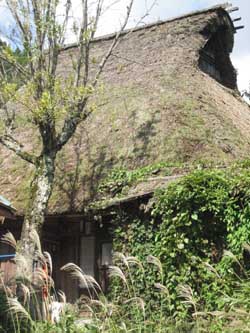
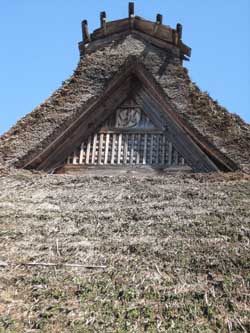
The pictures accompanying these waka by Ariwara Narihira (the aristocrat romantic of his time (825-880), poet of the Kokinshu and Ise Monogatari, as well as an alleged inspiration for the character of Hikaru Genji) were taken recently in a remote village in the mountains northwest of Lake Biwa called Ariwara Minka Shuraku, where Narihira is said to have lived, and where his grave is located. Not long ago there were many more thatched roofs and many more residents, but the young folks have been moving to the big city for quite a while now...

The woodcut above by Tsukioka Yoshitoshi (1891) depicts Ariwara Narihira looking for the ghost of Ono-no-Komachi on an autumn night.

Tuesday, October 10, 2006


TILT-A-WEB

A large orb weaver has chosen to weave her last web of this year (and her life) with one set of supports attached to the side of the big protruding kitchen window (that looks out over the garden) and the other set of supports attached to the opening side of the door to the deck, which triangulates her large web right in front of the door hinges, so every time I go outside her big-bellied chartreuse and red body with long striped legs drops about half a meter, either slowly or quickly, depending on my hurry. Then as the door slowly closes she pops back up into place as before.

Initially she was startled at these abrupt but smooth and apparently causeless changes in her elevation, and would flee for her life to one web edge or another, but now that it's happened many dozens of times to no harmful effect she doesn't even look around anymore. She's become quite at home being the only spider living at spontaneously varying altitudes, and remains serene in the center of her fine web as she suddenly plunges down and then up - many multiples of her body length (15 cm) - several times a day. Maybe she's even enjoying it, hard to tell, since spiders don't really smile. She picked a great place to build her last web though, best ride at the spider carnival...

Monday, October 09, 2006


MONKEY BLUESTREAKS


On Saturday while I was out in the garden being blown around by the hurricane and drilled by bullets of rain as I rocked down the covers on the firewood, I noticed that the first of the autumn shiitake had emerged from my oak logs, so I got a basket and finetoothcombed those logs until I got every mushroom and bud.

Yesterday when we came back from a windy but beautiful trip to another beautiful mountain village in Shiga (I'll post about that here as soon as I get my breath and don't have 20 hurricane-postponed tasks to take care of), in my last daylight task of the afternoon I was out clearing away some of the downed branches and other debris when I noticed that some species or other had been at the shiitake logs.

I went over there and saw that it had been monkeys, alright. Only they would make such a mess. This was worse than usual because of the frustration, you see. They had come dripping anticipatory saliva, found no mushrooms whatsoever, had a fit and blamed the logs (monkeys hate to be frustrated and never blame themselves for anything, traits still observed in some human world leaders). They turned each log in apish disbelief, then tossed them when they found no hidden mushrooms; they gnawed and clawed at the bark and ends of logs; there were logs all over the place, it was a picture of simian frustration.

They must have come just a short while before we returned home, for the air around there was still tinged blue with the atmospheric residue of monkey cursing. Monkey cursing is not a pretty thing to hear, even for humans; the phrases they use could not be repeated here, in the name of human decency, even if they could be translated (monkey bluestreaks can't be translated, since the personal priorities of monkeys are so much lower than our own; it's difficult even for indecent humans to imagine the depths plumbed therein), but if you've ever heard a veteran sailor at sea hit his finger with a hammer, what followed is diplomatic repartee compared to what the furry marauders emit when their apish expectations are as confounded as they were at my house.

Though unfortunately I hadn't been there to enjoy that delightful event in person (of course they wait till I leave, to do their marauding), I stood there wind-staggering and dripping rain with the smile of a higher species on my face: I had out-monkeyed the monkeys. I had snatched my mushrooms right out from under their flat red noses. For lunch today, I used some of the delicious mushrooms-at-their-peak to make a kind of country gourmet meal, and to add a little bit of nyah-nyah spice I ate it deliciously in the at-last sunlight out on the deck, letting the exquisite shroomy fragrance waft into the shiitakeless mountain territory of the big-time losers.

How sweet it is.