Saturday, April 08, 2006


SPONTANEOUS MEDITATION

Walking around the corner of the house early this morning into the full gold of sunlight I was caused to stop in my tracks, close my eyes and breathe deeply as in spontaneous meditation, mind emptied of thought and filled with a clear sense of nirvana here and now. I had walked all unexpecting into the heaven of fragrance shared by the Myrtle bush, every gleaming purple facet hinting at the beauty that bears us to each morning. When I came back to this world, it was new.

Friday, April 07, 2006


HAPPY BIRTHDAY, RONNI!

Thursday, April 06, 2006


AH, THE INNOCENCE...


I was chatting for quite a while with 5-year-old Kaya on the phone last night, now that she's old enough to be able to chat at length without just listening at the phone like at a keyhole, the way her 2-year-old twin sisters (Mitsuki and Miasa) still do.

Talking about her typical day in school and swimming class, and how the twins are always fighting but she never is, Kaya spoke so intelligently that in her physical absence I was lulled into forgetting that her mind is still only 5 years old.

As I kept asking her when she was coming to visit us again (as I do every time we call her) and pointing out that Echo and I are the only ones staying in this big old house, that we have lots of room and the frogs are singing, so she could come and stay anytime, she said that she was very busy these days (the frenzied modern 5-year-old lifestyle), then suggested brightly: "Why don’t you and Echo just have some more babies so you'll have somebody to play with when I'm not there?” I didn't know what to say to that, so I just listened at the phone like at a keyhole.

Wednesday, April 05, 2006

RAINY NIGHT EPIC

Last night I stepped out onto the deck in the whisper of new Spring rain and heard, in the rainfilling rice paddy across the road, the first two or three fresh-from-the-mud frogs of the year singing in top form - their voices clearly invigorated by their long sleep - about how amazing it was to be out here in the dark of the larger world once again, so rich in water above and below, just as it was last time they were here together in this very same place of long tradition, wasn’t it a delight their songs went, recounting once more the ever-astonishing adventure of having spent another dark instant of winter under the soil, which had clearly only recently been tilled, though they didn’t remember a thing about that; yet they’d all survived to gather here once more and sing the ancient tales to one another in calls and responses, just as their forefrogs had done all the way back to the beginning of everything there ever was and ever would be, as it has long been told. They sang on even as I was later falling asleep and lost track of the lyrics. No doubt they went on all night and exhausted themselves, for the morning was all sunlight and only the manic warbler was singing. But there's no keeping that kind of spirit down; I went out there tonight and they were at it again, in even greater numbers and louder than ever, singing once again the epic tales they never tire of.

Tuesday, April 04, 2006


DEATH AND PENSIONS


Whenever I dive into a stack of US government forms, such as for taxes or passports or military records, I get the same feeling I get regarding my luggage when I land at Kennedy Airport. It's basically an adversarial relationship from the get-go. But in this case, I'm the presumed would-be sneaking, lowdown crook looking to steal the goods. Which goods, however, were mine to begin with. Odd how things get turned around like that when you're dealing with the government your forebears established to protect your interests.

This basic attitude, directed equally toward each and every citizen (excepting those with accountants) is well reflected in the phrasing right at the top of the transcendantly titled "Statement of Claimant or Other Person" (who else is left?), one sheet among the many that comprise the small-town phonebook-sized packet of Social Security forms I as an expat have to fill out so as to get my own money back (I really don't expect much more, in terms of actual value), to which Agency I and my employers faithfully paid in full, all aboveboard, for a sufficient number of years: "I fully understand that a felony crime equals any crime punishable by a sentence of death or imprisonment..." Anybody else here on death row check the wrong box?

Every other form in the phone book as well, in one way or another, demonstrates this seriously distrustful attitude of the government toward me trying to steal my hard-earned cash: "...commits a crime punishable by under Federal law by fine, imprisonment or both." Well, nice to see you, too.

In Japan, though the government/resident attitude isn't exactly hail-fellow-well-met (especially at Immigration), I was never threatened with death on my pension forms.

Monday, April 03, 2006


RYOTANJI


We took the expressway, the faster to escape the mind-numbing clutches of the shadowy fingers that reached out for me as I raced away: "If 'Yes,' attach a copy of schedule C (or F) and SE and Form 2555 of your United States Income Tax Return filed for each year [!!!] of the work period shown in item 1."

Already my mind was clearing as I anticipated the calming and nurturing environs I would find in the small, temple-rich town of Hikone across the Lake. One of those temples is Ryotanji. I had ever been to that particular temple, though I've spent a lot of time in the town of the famed castle.

We were going to Ryotanji because we'd read an announcement about the Daruma festival that was going on there, which sounded interesting. I wasn't expecting much more than the general peaceful bustle and non-right-in-your-face spiritual ambience of the average temple festival, which qualities are always welcome in modern life - maybe with some unique cultural/aesthetic/historical aspects thrown in as mindgravy - but as it turned out, Ryotanji was a sleeper; it knocked my socks off.

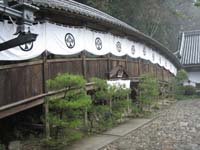
Tucked away among the hills at the edge of Hikone, Ryotanji was originally built in 734; it later became the family temple of the Ii clan, (who were given what is now Shiga Prefecture when they wound up on the winning (Tokugawa) side in the Battle of Sekigahara, which led to a unified Japan). Ryotanji carries that historic, spiritual and aesthetic tradition in every surface of its ancient presence.

From the brief brochure: "The teachings [at Ryotanji, Zenrenzai sect] specialize in the subject of landscape gardening, and many students who have studied here have gone on to be so called 'Gardening Priests,' establishing gardens in many temples throughout Japan." And what gardens; if you're in the vicinity, go there.

Not to mention the buildings themselves, or all the as-yet eyeless Darumas to purchase, take home, paint one eye in and promise the other in return for good fortune; or the images on the wooden doors, painted by Kyoroku Morikawa, a renowned student of Basho. Another great thing is that even on a Sunday, and even though it was a festival, there was almost no one there. Shockingly unlike the typical Japan Sunday event, when everyone goes wherever you're going. You could just sit there for hours on the temple veranda in the silence of the sun and the fragrance of incense, listening to the chanting, sipping your green tea, surrounded by masterpieces of every kind...

Now that's social security.

Sunday, April 02, 2006


Crow sits atop
the telephone pole
listening to my Stan Getz

Saturday, April 01, 2006


GOVERNMENTAL FORMS AND REALITY AS WE KNOW IT


With all the fresh-from-dreams bravado and apparent clarity of cranium that come with morning tea and Spring sunshine, this morning I dove headfirst and unprotected into the US Social Security fill-out jamboree I received from the Osaka Consulate, e. g., "QUESTIONNAIRE ABOUT EMPLOYMENT OR SELF-EMPLOYMENT OUTSIDE THE UNITED STATES," "STATEMENT OF CLAIMANT OR OTHER PERSON" and so forth...

There in the steadily darkening depths of bureaucratic ambilocution I came across one syntactic black hole after another, like the absence of ancient ruins of organized thought, that drew me on and on...

I know it doesn't pay to gaze intently upon certain objects, like the sun and governmental forms, but one can't help try to make sense of things...

Searching fruitlessly for some specific answers at the online SSA website, I came across this ominous statement (that would be more ominous if I had been working in the US): "I worked without authorization from the Department of Homeland Security (DHS). What proof of my earnings do I need to give Social Security?"

So I decide to put it all off till I'm a bit more governmentally minded, whenever that might be, and go instead to obtain some mercy at the Daruma Festival at Ryotanji temple across the Lake. It's a beautiful day, and I have a lot of genuine existence forms I have to fill out.

Friday, March 31, 2006


MORNING CALLIGRAPHY


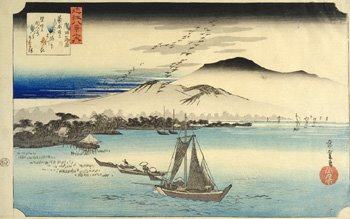
This morning while waiting in the falling snow for the train, which was late due to said snow (a lot of whiteness descended upon us during the night, rendering my left-out motorcycle into a sculpture by Dali), I was gazing into the distance along the quiet gray edge of the Lake, which was barely visible, when I dimly saw coming toward me out of the lacy whiteness a huge black wedge comprised of smaller black wedges, themselves made up of individual black wedges, flapping gracefully. It was the wild geese, heading toward their roosting places around Katata, as famously depicted in Hiroshige's Omi woodcut, Geese Sweeping Down to Katata.

While the inshore wing of the vast flock passed soundlessly only a few feet overhead, the outward wing trailed far back, streaming out low over the quiet gray water, growing thinner and thinner like the firm finishing stroke of a skywide brush-painting of geese heading home, on a parchment white as falling snow.

Wednesday, March 29, 2006

SONGBLOSSOMS

A couple of days of Spring, the plum blossoms just about to pop into clouds of white, and then I'm back out in the falling snow this afternoon, cutting firewood. That's mountain life. But then while carrying in all the firewood and stacking it next to the stove I got my reward: I got to hear the manic warbler over in the thick copse on the other side of the road, doing his beautiful medley (his version of the one Ludwig copied for Pastorale) for as long as his breath held out, the last few notes spaced further and further apart and growing progressively weaker until as I picture it he falls from the branch and lies on the ground gasping for air until he recovers his senses, then he's back up there again on behalf of the leafless trees, serenading the whole snowfalling mountainside. Guess that's how it is when you've been storing up that much song all winter and you just can't wait to give it all you've got, bring some fluid beauty into the still, cold world.

Tuesday, March 28, 2006


TELL ME ABOUT IT


I've been trying to teach Japan to swear for decades now, without any sign of success; it's hard to carry on with a string of internationally colorful epithets when no one understands any of it; the fun all leaks out somehow.

The fine art of swearing is the lifeblood of most societies, especially developed ones, like the US, say, or Italy, France -- Spain has a lot of really good stuff too. But in what would otherwise be the ideal situation for voluminously venomous vituperation, even the best stuff I've got, verbiage that would summon steam from the ears of a New York cabbie (I do my best stuff in NY) or generate a very capable counterflow from a French postal worker, falls flat in the face of the vast fluff of politeness that prevails here in Japan, where no one swears, even for fun.

Tourism Australia seems to have encountered the same problem, though I would have presumed they'd been here long enough to know better; they must have caught a Tokyo rush-hour train at some point in time. Anyway, they unwisely chose to use a couple of pabulum-level swear words in an ad campaign to attract Japanese tourists, but nobody here seems to get it. Apart from the fact that saying such a thing is, well, impolite (I can hear touristic mother-in-laws all over Japan saying, How could one ever make such a basely offensive utterance when inviting an honored guest? Unthinkable!), Tourism Australia seems to be unaware that the swearword vocabulary in Japan remains at the prenatal level, despite my years of effort.

There are, of course in Japan, as everywhere else in the world, any number of private occasions on which a lengthy and well-arranged parade of epithets would be right at home, at least theoretically, as when in my case I'm fighting a tight lugnut or hammering a lot of nails, or when in my garden I kneel on a chestnut burr or find my onions gone and such like moments, when I'm going one-on-one with the cosmos.

In public situations as well, such as at immigration or when I get an elbow in the kidney on a rush-hour train, a spontaneously selected American blend of colorful nouns and suggestive verbs - often with a soupcon of French, a staccato of Italian or some flaming Spanish (I even have some good Turkish stuff) - does the pressured spleen a world of good, but even in social settings here my swearing is purely unilateral; thus, half the effect, indeed the far more important half, is missing. This is even true with the large databank of gestures I bring individually to bear as appropriate; the other party just looks at me with puzzlement. No fun at all. So I've pretty much given up swearing in public here (excepting reflexive monosyllabics), I mean, what's the point, if no one is offended.

Hell, you'd think an organization like Tourism Australia would know better by now; they have a bloody Embassy here, for #$%&!sake!


In radical contrast...

Monday, March 27, 2006


CROW GUSTIBUS NON DISPUTANDUM EST


Finally, in this beautiful weather, got to go out into the garden and get my hands dirty, get some earth under my fingernails, and there found some sneaky depredation I hadn't spotted from the kitchen window.

Nor had I really looked, for it had never dawned on me that any bird would have a fetishy thing for dried and bagged fish meal. I'd left the bag out of the weather under the overturned wheelbarrow, and when I went to take the covering off my brussels sprouts found that I was standing in fish meal.

It was so deep that it covered my garlic, which had been nibbled steadily through the winter by the gourmet deer, who apparently enjoy the garlic fronds as a tasty garnish to my loquat tree.

The garlic had been making a comeback now that Spring had afforded the deer a larger a la carte selection, but even so, it was now buried in fish meal. I have no idea whether or not garlic enjoys fish meal in such quantity, though I shall soon find out at the end of this course in gardener education under Professor Nature.

I removed the wheelbarrow and saw that a large and ravenous beak, the unmistakable signature of Dr. Crow, had nipped and slashed and pulled at the bag until there was a large hole in just the right place to enable him to scoop out mounds of the stuff, far more than he could consume. A little forensic investigation told me why.

Clearly his larger plan had been to invite a number of darkly feathered creatures of his close acquaintance, who apparently love to wallow in fish meal the way Scrooge McDuck loves to wallow in money. The caucus members appear to have silently rolled around and flapped themselves silly in fish meal when no one was looking, especially me.

I scooped up as much fish meal as I could (the garlic will be interesting to watch), bagged it securely and put it in the toolshed where beaks of darkness can no longer get at it. They'll just have to find some other way to enjoy themselves at my expense.

Saturday, March 25, 2006


For just these moments
before the plum tree blooms
I can sit on the corner of the deck
with a beer, put my feet up on the rail
and gaze on the blue lake at evening
through all the whitening buds

Friday, March 24, 2006


CENTAUR GENETICS


[Excerpted from my old journal, The Biwa Book]

[Feb 2000] One snowy night last month there was a knock at the door; I opened it and there was a white horse standing there. On closer examination, though, it appeared to be a centaur (the everyday mind isn't really prepared to make such distinctions): no, it was a person wearing a horse mask, a white horse mask, a very realistic white horse mask out there in the snow in the night, and I knew it had to be Keech.

No one else would come up the mountain to our house on a snowy winter night and knock at the door while wearing a white horse mask. The mask came down all the way to spread slightly over his shoulders, completing the illusion of oneness, of centauricity. Knowing Keech I didn't bother to ask why he was wearing a horse mask, because he wouldn't really see the point of such a question. Anyway, he was a horse at the moment.

I had thought that this spontaneous mask-wearing was simply an eccentricity unique to Keech, but then Echo told me that when the monkeys had come to our house and garden one afternoon, she had put on the horse mask and run out into the garden and the road in broad daylight, as if I myself weren't strange enough to the neighbors.

Then the other evening, when Echo came to the station to pick me up in the van because of the snow, there was a white horse sitting in the passenger seat. I had to take the wheel because, although the subject never really comes up, everyone tacitly agrees that horses can't drive.

Now I know it's not Keech; it's genetic.

Thursday, March 23, 2006


IDLE THOUGHTS


This is something you learn best out in the country, where time is measured in sun, moon, stars and the size of leaves, where there are no schedules, streets or 50th floors, no scramble intersections. When you move from the city out into the countryside, further from the need for minutehands and closer to the actual time of day as quietly and naturally registered on your consciousness by the entirety of sky, you begin to acquire the ancient awareness that is inborn in us all and was once lifelong from the start, that you are in charge of your time, as opposed to when you agreed to a salary. The aboriginal employment arrangement is a very different one, one we all yearn to practice -- when we make our million -- when we retire --

But at whatever age, once in the wildflower meadow's thrall we begin to perceive the aboriginal nature of idleness, the Eden of ideas. All of history's great creators were masters of idleness, but they were only idle to the busied eye. They were idle where it matters. One who hasn't mastered the art of idleness has been living secondhand, without a firsthand.

Idleness punctuates the new idler's life, gives it organic pace and pause, imparts perspective on what once was a blur, enables snapshots, moments of assessment and redirection, the creation of a mindmap of the life's path, thus the idler learns of life from the inside, where it's lived and where it happens, rather than from the outside, where it is chronicled by a timeline of arrivals and departures.

It is a blessing now and then to stop mid-task, the way all deep tasks are designed, sit back against a tall tree, the way all tall trees are designed, and let the moment's momentum take its course as you ride the timestream like a twig, letting eternity itself assert your part in it.

When at last you return, you come bearing gifts.

Wednesday, March 22, 2006


CHINA-JAPAN RECONCILIATION BLOG


Here's a great example of how blogs can aid in democratizing international relations.

"In August 2006, the Department of International Relations at Australian National University will host a workshop on reconciliation between Japan and China. Preparatory to the organization of that workshop, we invite you to brainstorm the topic electronically through this blog. The purpose of this blog is to invite discussion and debate about the best ways to encourage reconciliation between China and Japan."

Reconciliation between China and Japan: A Search for Solutions

Tuesday, March 21, 2006


WELCOME TO SPRING!


Here's to full bloom.

Monday, March 20, 2006


PERFUME IN RAIN


If you can imagine the beauty of orchards of bursting-blossom plum trees in a strong Spring rain, each tree carefully pruned and tended, all arrayed on green slopes surrounding an establishment that has been growing cherry and plum trees for many centuries, then you are where we went next.

In the continuing delight of heavy rain (Japan shows another side of its beauty in downpours), after our descent from Tachiki-Kannon we decided to visit a place Echo insisted I had been to, but that I insisted I had never been to, which made it all the more interesting. My memory served me well; I had never been there. Either that or I've forgotten that I have selective amnesia. For some reason, Echo had generously included me in her own memory of visits there.

'There' is Sunainosato [click the index boxes on the left of their page for additional photos], a place of vast, free-access acreage (private property that is both vast and free is rare in Japan) of cherry and plum orchards that has been dedicated to creating Japan's finest traditional sweets since the Edo era, if not longer.

What do cherry and plum blossoms have to do with sweets? The folks at Sunainosato (who all dress in traditional clothing) use the blossoms, leaves and fruits they harvest there for making such traditional Japanese sweets as my favorite, sakuramochi, cherry-blossom-pink rice paste filled with sweetened bean paste (the only form in which I like it, apart from hot taiyaki), wrapped in a slightly salty, fragrant and crunchy cherry leaf. The cherry perfume from the leaf stays on your fingers long after you've eaten the delicate mouthful. In Japan, the appearance of a food is at least as important as the flavor. To me, sakuramochi , with its lingering perfume, epitomizes that quality.

That quality was protomanifest in all the rain-wet tree trunks, stark as black-ink brush strokes in their living, sun-striving angularity. Ordinarily a dull gray, the rows upon rows of trees on this day were lush with wet, their swelling buds a faint pink radiance clouding the green hills around the old style buildings. The buildings themselves are artistically arranged amid well-tended gardens and other orchards, with walking paths leading to all sorts of treasures, not the least of which is the inner sanctum, where all the sweets are on display and the choice is difficult, even for sakuramochi fans.

Needless to say, we bought sakuramochi (a box of three) and savored their taste and perfume to the sound of rain among the quickening trees.

Such are the ingredients of life's miracles.

Sunday, March 19, 2006


IN THE ABSENCE OF THE WHITE DEER


Yesterday despite the rain we went to one of my favorite nearby holy places, Ishiyamadera (where Murasaki Shikibu stayed for a while and wrote part of Genji), to see if the famed plum blossoms were out. They weren't, so we postponed the plum-blossom visit for another week and decided instead to travel a bit further along the Seto River, a very impressive jade-green burly rush that shoulders itself from Lake Biwa to the sea, providing water to Kyoto and Osaka and all towns in between.

We were headed for the place where Kobo Daishi (aka Kukai) stood at the Seto riverside 1100 years or so ago and saw a strange light shining up on the mountain. Just as he decided to go up there and investigate, a white deer appeared and offered to transport him to the place. Up he went, and there founded the small temple Tachiki-Kannon, where there is now a statue of Kobo Daishi riding a deer and where a famous 12-headed Kannon now resides.

When we got to the very same starting spot though, and stood by the river looking up the steep mountainside, no white deer appeared. Rather there were 700 high stone steps to bear us up to the tree-shrouded top, with conveniently shrined stopping places along the switchbacks where gasping pilgrims both younger and elder can pause and pay their breathtaking respects to the holiness that got them this far and pray for the fortitude to continue.

When at last we got to the top we were in pretty good shape for a couple of elders, though parched from gasping, so we went right away to get out of the rain and have some of the free tea that has been on offer there for just that reason for over a thousand years, then sat and sipped beside the big bronze tea-water cauldron in the small open-sided tea space and viewed the temple precincts. It was very like traveling back in time.

Because it is rather confined in size and sort of out of the way, and because there are 700 steps up to it, Tachiki-Kannon is not much visited in comparison to Ishiyamadera (there were maybe a dozen visitors when we were there), so change is slow. And since time is change, it was interesting in detail. I love places (and people) that truly honor their own age. Definitely worth the trip.

Heading back down the steep steps was a lot easier, like life when you get past 40.

When I get my breath back I'll tell you about the great place we went next.

Saturday, March 18, 2006


STILL HOPING THEY'RE WRONG...


But a US public and private debt 18 times this year's Federal Budget?

"Nine indicators prove that the crisis is unfolding:
Nine indicators developed in this month's GlobalEurope Anticipation Bulletin No 3, which I coordinated, out of which 5 are presented in this public communication, enable LEAP/E2020 to confirm the beginning of a global systemic crisis by the end of March 2006. The recent international trends that particularly affect the international financial system, and the preoccupying trends in the US, namely as concerns the reliability of statistics on the US economy, have brought our research team to conclude that this global systemic crisis is already unfolding....

M3 is really the decisive indicator
As illustrated by most of the 5 indicators developed in the present communication, the last weeks have confirmed how decisive is the US Federal Reserve's decision to stop to publish M3 on March 23, 2006. LEAP/E2020 is now convinced that this decision anticipates a period of acceleration of money-printing by the US, concealed behind public declarations of inflation handling, that will result in the collapse of the US Dollar and in the monetarisation of the US debt (public and private), which a growing number of US experts now estimate that it will never be reimbursed considering its gigantic amount in constant growth (the US public debt now represents more than 8,000 billions dollars, i.e. about 4 times the federal budget in 2006). According to the very conservative Heritage Foundation, if we take in consideration the consequences on the budget of recent decisions made by the Bush Administration regarding health and pensions, the real debt is of 42,000 billions dollars, i.e. 18 times this year's federal budget, and 3 1/2 times the US GDP in 2005."

Japan seems to agree...

Looks like it might be time to get out of dollars...

Whole story in Newropeans Magazine

And a straw for the camel's back....

Friday, March 17, 2006


ERIN GO BRAGH, FAR EAST


All you folks who reside in countries where calendars are not in kanji and have March 17 marked in green with a little shamrock or a leprechaun, and where people come to the office wearing green ties or ribbons even if they're not Irish, well after work today you can just go have a green beer or two for a guy named Brady, grandmothers nee Kelly and McTeague.