Tuesday, May 31, 2005


VILLAGE LIFE

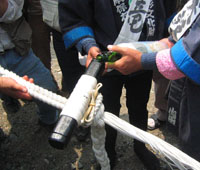
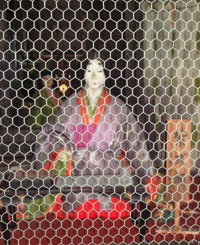
And behold it was a village in the countryside, not many hours from the big city; there among the trees, the narrow streets and the old farm houses a festival was going on in which, among the villagers attending – the elders and the drunks, the kids, the mothers and the fathers – young macho handsome guys put on old tapestries like skirts, danced in the streets and didn't even begin to laugh at one another, wore long red hair and masks and gestured crazily in the complete confidence that deep tradition affords, for tradition is a great strength, the bond of a society.

And so it was good, it was food, to go to that far village fest and behold the young performing these rituals as they had been told, and as these village young have always done, for all the young lives till now and without complaint, for this is the tradition of their place, this is what they have been and are living, the tradition of their forebears far back. So it was that the young went through what for the young is hell: a pained and protracted learning of ancient rituals that have no place in this real world, that take time and slow it down then bend it backwards, when all the thrust of the modern world is forward at top speed into a future made in offices.

To their immediately personal eyes and minds, this ceremony was the stuff of old folks but they did it anyway, faithfully; and so, as you could see in their faces, as the rite took place they began to sense the value of this social bond, that through them, and all the eyes on them, holds all this together against the fast-approaching, sky-sized metablob of uniforming change that is oozing toward them and their village on all fronts; it was food to see and know that what is left in the local heart can still hold together in the face of that onslaught, that the young can still be turned to the good of all in a village where not all youth is leaving for the facelessness of the big city world and its apartness, when here the folk and their place are so together-rooted as to germinate hope for the ancient reach of us each in the world, that hearts may bear this hard-won wisdom beyond this new age to where newer lives will take it up, make it their own and hand it down, so that what is good about growth will go on.

Previously published, in slightly different form, in Kyoto Journal #57.

SMITHSONIAN SHILLS FOR INTELLIGENT DESIGN

The Smithsonian Institute, bastion of science, world symbol of humanity's quest for genuine knowledge and public institution, it turns out also sells a little on the side, if the money's right. $16,000 appears to be the street price for the illustrious name and the appearance of its endorsement. (Adamant denials notwithstanding as the money goes into the pocket.) I won't further unintelligence by linking to the egregiously misnamed party with the bucks.

via James Randi

NYT article

Later statement (June 1) from The Smithsonian:

"The Smithsonian's National Museum of Natural History recently approved a request by the Discovery Institute to hold a private, invitation-only screening and reception at the Museum on June 23 for the film "The Privileged Planet." Upon further review we have determined that the content of the film is not consistent with the mission of the Smithsonian Institution's scientific research. Neither the Smithsonian Institution nor the National Museum of Natural History supports or endorses the Discovery Institute or the film "The Privileged Planet." However, since Smithsonian policy states that all events held at any museum be "co-sponsored" by the director and the outside organization, and we have signed an agreement with this organization, we will honor the commitment made to provide space for the event."

Also via James Randi

Monday, May 30, 2005


YOKKAICHI KITE FESTIVAL: AMONG THE KITE FANATICS

You know how it is when you build a kite that's bigger than your house and weighs about a ton: on the big day you're set to fly it, it rains, right? It's always the way. So you postpone the big day till next week. And because in the case of which I speak your giant kite is made of bamboo and rice paper, watercolored in painstaking detail with symbols of flight and wind and power, you can't just leave it out in the rain, you've got to store it somewhere - somewhere big - but nothing's so big in Japan that's also empty, so you throw a couple dozen tarps over your kite and wait till next week.
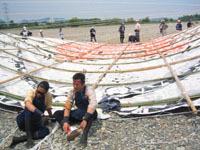
And as is also always the way, next week's big day dawns blue and bright, with puffy clouds just hanging there, like popcorn on a string, in the kitist's anathema: still air. That is, air in which the motion of one's own breath is impressive. So when we arrived late in Yokkaichi for the big festival (postponed last week by rain), it didn't matter: at kite takeoff time there was barely enough wind to lift a tiny paper tissue kite above eye level if several folks blew upward.
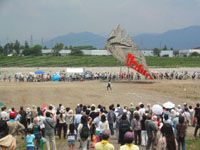
In quest of a breeze it took a few hours of massively collective waiting and mob-shifting the huge kite from one direction to another and back again in the dry part of the wide riverbed, but at last in the afternoon the big kite took off, to the sound of an immense sigh from the crowd that seemed to lift the kite a bit higher. I've never seen so many kites or kite fanatics in one place before. It's a great thing to know that so many love what I used to misguidedly think of as a kid's toy. It was a pleasure to stand corrected among them and watch them at their art.
Sunday, May 29, 2005


KITE CITY, HERE WE COME

Off this fine May day to see the Yokkaichi Kite Festival, postponed from last rainy weekend; back later.

Saturday, May 28, 2005


REFERENDUM WITH FROG

As this morning we were returning from our walk, Ms. M, coming down mountain in her car, stopped to chat about the recent referendum on dissolving the town council, as referred to herein a few days ago (update on that: our side lost; the town council will not be dissolved; plans for the spanking new 24/365 gas plasma incinerator in the forest above the Lake will now go forward to meet our next phalanx; also, our township of Shiga-cho will be merged with and become Otsu-cho next year, so that the "hantai" voters hereabouts will have a new town council anyway, with higher taxes and much less influence).

As we chatted on the roadside about such faits acompli, I noticed a bright green frog on Ms. M's car roof. The roof was beginning to heat up in the strengthening sunlight, and you know that story about the boiling frog; also I was thinking that if the frog waits and at last jumps while the car's doing sixty, it's crow breakfast. Since we were stopped beside a rice paddy, while Echo carried on the conversation I tickled the frog in the rice-paddy direction along the hot roof, but since it was cooler where he was than wherever he went, he didn't like to move. He preferred to stand still and broil slowly.

The conversation was winding down, so I tried to grab him; he leaped a big one, then, but into a roadside culvert; so, now that I was committed to this green enterprise I had to bend down and get him out of there, which wasn't easy, since he was hopping freely now. But at last I caught him and set him well-aimed on the paddy verge, where he paused as if to assert and savor his own sovereignty; then he leaped, landed in the cool, bright water and frog-kicked away into its vastness with glee enough for both of us. No referendum ever felt better.

Friday, May 27, 2005


HEAVILY ONIONED GRATITUDE

The other day in the big city office I met Ken Rogers, managing editor of the Kyoto Journal, among other things on his diverse resume. Knowing well of my severe and protracted (if not permanent) dearth of garden-fresh onions, Ken was so kind as to present me with a very large bunch of ruthlessly purple onions from his very own garden to help me through hard times, onionwise. Ken, as you may have surmised, lives just over the mountains in the oddly monkey-deficient regions of northern Kyoto.

I pondered the diversity of nature's largesse as in heavily onioned gratitude I walked from the station up the mountain to my home, jauntily-tauntily flaunting the bag of fresh and fragrant onions before the very noses of the monkeys I knew were there in the roadside forest watching, putting little check marks next to my simianese name in their organizers, I saying loudly to no one in particular "boy are these fresh onions going to be good in onion sandwiches and salads and bolognese sauce and fried onion rings, to say nothing of onion soup and quiche..." and on I went all the way home naming onion meals, swinging the bag, spreading onion incense on air that was even now filling with the sound of simian saliva splashing on the forest floor... A delightful walk.

I'll have to ask Ken if he needs anything over there in north Kyoto; wonder if he'd like a fresh bunch of monkeys...

REAL MEN DON'T CONSERVE

"Japan has exported into the U.S. market two cars, the Toyota Prius and the Honda Insight, that each get better than 60 miles to the gallon by utilizing a hybrid electric/gasoline engine. The Washington Post reports that the two Japanese hybrids are virtually sold out in the U.S.

There is a five-month waiting period to purchase the Toyota Prius, which has become something of a status symbol among progressive politicians, such as Maine’s Gov. Angus King, and Hollywood celebrities, such as Leonardo DiCaprio who owns two.

Meanwhile, the Bush administration has proposed slashing about 35 percent of the funds for the public-private partnership with U.S. auto manufacturers to develop more fuel-efficient cars." [While phasing out the $2,000 tax credit for hybrid vehicles, but keeping the $25,000 tax write-off for Hummer or other large gas-guzzling SUVs.]


ORANGE ON A TABLE

The other night as I went out walking downmountain in the still air bequeathed to evening by a fine day, as I rounded a curve and emerged from behind the line of roadside trees that screened the Lake from view, there in the otherwise clear sky across the water was a long level of cloud stretched out perfectly flat like a table atop the far mountains, a table as draped in the sheen of fine gray silk. Resting atop the table was one very large, round and fully ripe orange, apart from the size and color having precisely the brightness of the moon, it's orange light speckling all the Lake like firework embers. I could only stand and watch it change as it rose, with the same feeling I get when cherry blossoms fall.

Thursday, May 26, 2005


BASHO'S FINAL HAIKU Part II


It was no mystery that Basho, at the end of a life spent wandering in pursuit of plain and humble beauty, chose as his resting place this small, quiet temple that perfectly manifests the principle of sabi, its thatched roof the earth-brown color of Basho's robes. It is also no mystery given the view of the Lake this place afforded during Basho's time; he visited here often for poetry gatherings and no doubt steeped himself in its history.

The mystery for me was why Basho, after an entire life spent in pursuit of the ephemera of words, as a lover of beauty, as a recluse who lived much of his life in simple austere refinement, as one who named himself after a useless banana plant (growing in a clime too cold for it to bear fruit) and having visited the many beautiful places in Japan on his far wanderings, should in his will reveal the wish to have his grave placed beside that of Kiso Yoshinaka, a renowned, ambitious, vengeful warrior who had been slain by his Minamoto cousins on the spot where this temple, Gichuin (Gichu is another pronunciation of Kiso's name) was built to commemorate him, warrior star of the Heike Monogatari, centuries before Basho was born.

Basho himself was born to a lowly samurai family of Ueno and was reputedly a ninja (Iga-ueno was (and still is) the ninja ‘capital’ of Japan), but not much credence is placed in this theory, which might link Basho-as-samurai to Kiso-as-samurai. I think it's more likely, given Basho's skills, that in choosing this place he did the same thing he did in his poetry: he combined very disparate elements to great dissonantive effect. Much more evocative than a monotone grave in a forest somewhere.

So there they lie, side by side: the tragic, vainglorious, multiply betrayed warrior and the simple, reclusive wandering poet, in precincts dotted with many haiku-carved stones - placed there by Basho's students and admirers over the centuries - and the grave stone of Kiso's Kyoto mistress over there in the corner (she killed herself upon hearing Kiso had been slain; Kiso's wife was forced to marry into the victorious side of the Minamoto clan, later became a mendicant nun and returned to Nagano in her final days...
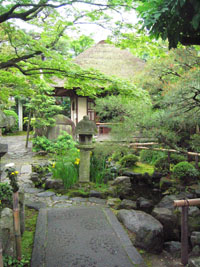
By choosing to reside in these simple grounds, Basho has created his final, unspoken and unending poem, evoked in the spirit of all who come to visit here and let the long silence tell the stories that lie quietly in this place...

***

Here's an English translation of Basho's "The Narrow Road to the Deep North" (Oku no Hosomichi).


Tuesday, May 24, 2005


BASHO'S FINAL HAIKU - Part I


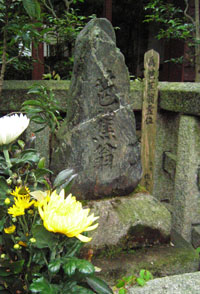
After our visit to Ishiyamadera we went looking for Basho's grave, which I'd been surprised to learn was in Otsu (where Basho spent lot of time) and had since wanted to visit. In our fully intact expedition naivete we didn't need a map, of course; who would need a map to find the small-town grave of Japan's most famous poet and the whole world's haiku master?
We simply got off the train at Ishiyama Station and headed in the general direction down one of the narrow streets that follow the slope toward the Lake, looking for all the signs and other myriad indications that would no doubt surround the famous final precincts of such an illustrious artist - pointing fingersigns, flags, fireworks, billboards, neon signs flashing "This way to Basho's grave," hot dog stands, loudspeakers, haiku recitations, haiku CD hawkers, fleets of tour buses and what not: these would lead us to the location of one of Japan's must-be-most-famous tombs...

There were a lot of interesting shops to see as we walked and walked around and around: a bakery, a mahjong tile shop, a bicycle shop, a great looking sake bar, but just typical old-Japan neighborhood shops, no sign whatsoever that the supreme being of haiku was anywhere within a hundred kilometers of where we journeyed along the narrow road to the deep nowhere. Not even a Basho t-shirt store; I would've bought one. We checked the local area maps that are posted here and there at key intersections to aid seekers of known addresses (buildings in Japan are addressed in the order of their construction, so a known address is about as useful as "go south"), but the maps had never heard of Basho, or his reputed grave.

So we asked a young woman who lived around there, she didn't know. We asked in various shops; an elderly man (the elderly remember the ancient things) said "it's down there somewhere, ask down there." We went down there and asked, they said "ask over there, they might know." Over there they said "it's down that narrow alley over there, you see that alley? Go down there."

We went down the narrow alley, still no signs of any kind bespeaking local pride in the fact that Japan's most famous poet, the guy who wrote the world-renowned frog haiku, was resting just a gravestone's throw away. We came out of the alley and there, from over the non-descript wall of an unassuming precinct along a side street peeked a couple of basho (banana tree) leaves, especially green in the rain. That must be the place. What a haiku, bright basho leaves telling us where Basho was. Bet that was his idea.

Nobody else in the neighborhood seemed to notice. We were the only ones there, for our entire visit. It appears that Basho, who never liked fame and preferred seclusion, had chosen his gravesite well, in a humble place amid local folks who honored his wishes. And there in that small, quiet temple in the rain I encountered another of the many mysteries about Basho...

(To be continued...)


Monday, May 23, 2005


IN LIGHT OF RAIN

Went in the rain to Ishiyamadera and realized anew, in all that wet and verdant beauty arranged along the mountainside, the deep truth of Inei Rai San, Tanizaki's rambling discourse on Japanese beauty.
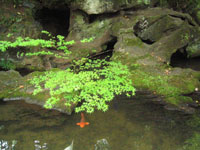
Ishiyamadera was meant to be seen in natural dimness; even better, in the light of rain. With all its fantastic rock formations and hidden groves, recesses and pockets of natural elegance finely maintained, the temple has anciently drawn Japan's artists; Murasaki Shikibu is said to have written some of The Tale of Genji here, in a room now named after her.

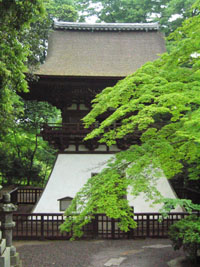
Not to mention the layout and architecture of the buildings carefully positioned throughout the forested mountainside (the elegant Tahoto (Treasure Tower), the oldest such building in Japan, was commissioned by Yoritomo Minamoto), in one of which Basho himself stayed awhile, no doubt enjoying what must have been a fantastic Seto-river-and-moon-viewing and haiku-writing platform back in the Basho days.
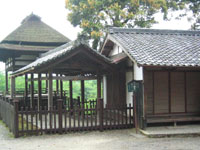
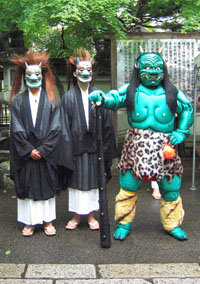
We slowly wandered that sampling of paradise for a few hours, hung around with the demons a bit and then went looking for Basho’s grave, said to be not too far away...

Sunday, May 22, 2005


WET KITES

We were planning to go across the Lake today to enjoy the Odako Matsuri (Big Kite Festival) in Yokkaichi City, which is famous for kites (but terrible at internet PR; Googling the phrase “odako matsuri” gets but 4 not-too-informative or graphic mentions, all in Japanese, for a very well-known festival) and where today they plan to fly a 100 tsubo-sized kite (one tsubo = 3.3 m2) weighing over 700 kilos, which is a big kite, indeed can be deadly in high winds, but in the event of rain – paper kites are no fun in rain - the Festival will be postponed to next weekend and it’s raining very calmly right now, so we’re going with plan D, which is to head for Ishiyamadera in Otsu at the Lake's southern end, where the Ao Oni (Green Demons) are dancing today - and demons dance, as we all know, rain or shine. I'll stick a demon foto in here if I get any decent ones in the rainy-day lighting...

Saturday, May 21, 2005


out of my pocket:
not my glasses -
a mushroom

Friday, May 20, 2005


FULL HARVEST

"While there are still those diehards in the medical community who preach the old dogma that supplements aren't necessary if you eat a "balanced diet," it is nonetheless a fact that animal feeds ALL contain nutritional supplements. Agricultural experts recognize that farmers must supplement animal feeds. They know that the grain and other foodstuffs do not contain enough nutrients to maintain healthy livestock without adding supplements. If animals can't stay healthy eating our modern crops, how can human beings?"
...............

"What you need to grow good quality plants is good mineral nutrition, good digestion in the soil, and the appropriate cosmic wavelength that we call sunlight and a good quotient of old air in the soil to feed the digestion, which is compost, and a good clean air environment so that the plants can absorb non-polluted air to build on and function. I use rock dust and oyster shell and rock phosphates and crushed rock. I couldn't grow a garden without mineral supplementation. Every enzymatic process is built around a mineral element -a single element or a mineral compound. And enzymatic processes control all life. So, delete minerals, you got problems. Listen to the land-grant colleges and feed plants that old commercial NPK stuff and you're guaranteed to have imbalances. You can't force something to grow to completeness. You can only nurture it to grow to completeness. And it's so easy to do it right. And it's so hard to do it wrong!"

Excerpted from the book entitled Empty Harvest by Bernard Jensen and Mark Anderson.

And "'Hydroponics? Ridiculous!' A Real Farmer Looks at Medical Marijuana'" at Counterpunch.

Thursday, May 19, 2005


ALONE WITH MAYONNAISE

As I stroll the mountainfoot village byways and outlying roads and pathways on my local springtime rambles, as an erstwhile onion grower I can't help but feel a recurring twinge of virtual nostalgia over what never was, when I note the local inhabitants' unconstrained success at growing onions to an extent that is practically offensive - rows and rows, columns, regiments, divisions, standing armies of onions - that over time swell like liquid pearls at the base of proud green leafspears rising sturdily above the brown earth like flags of the vast onion nation, open to the sun and heedless of the wind, marching onward into kitchens, the while transforming soil into something that excels atop a cheeseburger or as fried golden rings or just makes a great sandwich alone with mayonnaise, to say nothing of the many roles of onions in the salads and sauces of this world, and I say to myself: there are no monkeys around here.

Wednesday, May 18, 2005

Tuesday, May 17, 2005


TOKYO'S 'THE STUDY GROUP RELATING TO THE PREVENTION OF BEHAVIOR THAT CAUSES DISCOMFORT AMONG NUMEROUS PEOPLE IN PUBLIC PLACES' BEARS ITS FANGS


Neo-impoliteness is making steady headway in Japan, the land of perhaps the greatest degree of social politeness in history, with the exception of World War II. I remember when I first arrived here, seeing two drivers - whose automobiles had just collided - bowing deeply to each other at the roadside over the unpardonable offence each had just committed against the other. Their insurance agents probably sent each other a couple of those $300 melons.

As to the nether extremes of this rampant courtesy, the complete lack of decent swearwords in Japanese has frequently been a drawback to my own efforts at appropriate social engagement in the Land of Wa. English swearwords, no matter how powerful, simply fall dead to the ground like songbirds hit a plate glass window. That's how polite it can get here.

Used to get, that is; for now, in the face of the staggering impoliteness currently spreading throughout the archipelago like a barbarian invasion in the form of such feckless behavior as using strong perfume, carrying large bags, kissing, infants crying, sitting on the floor, eating in public, using an umbrella to practice golf swings and that vexing bugaboo, taking up too much room with one’s newspaper -- the list of extreme social violations is a long one. Whether these would make the cut in NYC is another matter altogether.

But not to worry; the STUDY GROUP RELATING TO THE PREVENTION OF BEHAVIOR THAT CAUSES DISCOMFORT AMONG NUMEROUS PEOPLE IN PUBLIC PLACES (SGRTTPOBTCDANPIPP) will find the answer.

Now I wonder if there’s also a STUDY GROUP RELATING TO THE INVENTION OF WORDS THAT CAUSE DISCOMFORT AMONG NUMEROUS PEOPLE IN PUBLIC PLACES. One needs something effective to say to all these impolite people.

WILL JAPAN HAVE THE FIRST HUMAN WEEDS?


Not that human weeds is a new genomic concept, but Japanese researchers at the National Institute of Agrobiological Sciences have successfully inserted a human liver gene into the rice genome. Was their purpose to make rice more like us? To create kindred meals? To give that bland looking grain a human face? To make rice taste like liver? Look like liver? To make rice more delicious, maybe? More nutritious? That might be good. Healthier for our children’s livers? None of the above. By inserting a human liver gene that makes CPY2B6, an attractively labeled enzyme that is good at breaking down harmful chemicals in the body (we know where all those chemicals come from, don’t we) their purpose was to make the rice resistant to even more agricultural chemicals!

The objective was to produce a strain of rice that can withstand even more of the countless agricultural poisons used on our growing foods! Any rash insect or fungus or wilt that dared approach the new frankengrain - with its you-and-me component – could then be shot, gassed, nuked, cyanided, arseniced, PCB’d you name it, and still make it to your dinner table in a form resembling rice, with perhaps a bit of a liverish tint and a subtly chemical aftertaste. Can scientific motivation get any nobler than that?

Some geneticists are wary of what might happen if the liver gene should get into, say, weeds, that might then want to take over the world on behalf of the one true liver. But no need to worry; the men in white are on the case. Finish your rice, kids.

More on this

Monday, May 16, 2005


TREES NEVER SLEEP

Bucking, quartering and splitting firewood is an extremely educational process, to say nothing of the bodily risk involved, as I’ve indicated many times in these unworthy chronicles. But the education afforded by hardwoods is not like college: it never ends. And in college a professor is unlikely to remove any of your fingers or toes. I’ve been firewooding for about ten fully educational years now, and today I learned a new one from firewood’s bag of tricks that's going straight into my Firewood Tactics Analysis File.

You’re halving then quartering a bucked section of oak with the splitting maul. As you are halving it, you introduce the following wedge to free up the starting wedge, which you then use to begin quartering the log while keeping the halves yet relatively intact, for stability. Once you’ve got the quarters to the point where you feel you can pull them apart by hand, you drive the maul head solidly into the top of the conniving chopping stump to free both hands, pull off the first quarter of the log, thus freeing the following wedge that was still inside; it falls in all apparent innocence to the ground.

You then try to pull the second half into quarters and find that they are still too strongly bound together. To free them, you need the following wedge. Later, you realize that the wood has known this all along. With one hand holding the unstable half-section and your mind focused on getting the wedge, you bend over the maul handle to pick up the wedge where it has been deviously tossed by the firewood; your chest presses to the precisely planned degree on the perfectly positioned maul handle thus freeing the maul, which, through its own counterweight, flips and thuds impressively into the ground exactly where your uneducated right foot would have been but for the agility that can still avail beyond the age of sixty when the moment requires.

So I remind myself once more: Do not sleep in the slightest while firewooding, because trees are always awake.