Saturday, September 30, 2006


GRUB GRUB


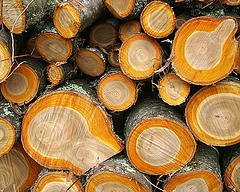
Last summer in my hurry before leaving for the states I sectioned and stacked a half-cord of oak where it was most convenient at the time, beneath the plum tree, and obverse to the prevailing wind. As a result the wood couldn't dry adequately, so the wood beetles and fungus-cultivating ants renovated it into an insectivoral Beverly Hills Grand Hotel. In further consequence, this morning I was out early continuing the task of stripping the damp bark off the sections under the watchful eyes of butterflies, dragonflies, a frog in his niche in the deck joinery, and Dr. Crow, who was up in the chestnut tree burbling over the prospect. He knows that whenever I do this I uncover handfuls of fat white wood-beetle larvae, some the size of Wichetty grubs, that dine on the oak cambium layer and into the wood itself, and when exposed just fall to the ground and lay there invitingly, like crow antipasto.

When I first started splitting oak around here, splitting trunks 2 feet in diameter at the time, a villager stopped by to watch and commented that if I found any of those big white oak grubs, they're really delicious, a traditional local delicacy, like Osuzumebachi (giant hornet) larvae. I passed on it at the time and have since continued to do so, though the grubs are as big as shrimp, and I'm sure that in a time of no food they'd make quite a tasty (and organic) gumbo. Anyway the Crow family has known all this stuff for eons, and he couldn't wait for me to leave his restaurant.

As I was working I kept hearing the acorns fall on my upmountain neighbor's ceramic tile roof, causing me to recall that unfortunately for my neighbor he hadn't thought, before he built his log house, to cut down the big oak or at least the branches that right overgrow the roof; and for a number of weeks this time of year, the crafty old tree releases its thousands of acorns one by one (like a machine gun if it's windy); the hard nuts strike the roof here and there like bullets, rebound all over the deck and against the glass doors, making a nutty racket 24 hours a day, waking my neighbor up at night. And of course the pattern of acorn ballistics is completely random, which is much worse; he lies there waiting...

Our chestnut is now also doing the same thing - something to be careful of when you walk under the tree - and its spiky missiles are much larger, thudding on the deck and rebounding off the big glass doors on two sides of our house, which can be startling in the dead silence of evening, but very considerately the chestnut does this only for a few days, and not during the night. Or maybe I sleep too soundly...

Enough of these musings; getting hot as we near noon, time to have lunch and let the good Doctor enjoy his antipasto.


SHOPPER'S GUIDE TO PESTICIDES IN PRODUCE

"The Environmental Working Group (EWG) ... is a not-for-profit environmental research organization dedicated to improving public health and protecting the environment by reducing pollution in air, water and food. For more information please visit www.ewg.org."

Friday, September 29, 2006


BE A MICROFINANCIER


I’ve always admired Grameen Bank of Bangladesh, which provides ‘microfinance’ loans to poor individuals who seek to better themselves but aren't considered credit-worthy by standard banks. A beautiful idea.

Late last year I found a site called kiva.org, which arranged for small loans (by western standards) by folks like me to needy entrepreneurs in developing countries, the loan to be paid back at no interest. I joined right away, but since they had just started they were only working in one village in Uganda, and had run out of loan applicants! Yesterday I received an email from them, saying:

“We now have a large number of low income entrepreneurs from 12 countries in need of loans ... And each week, our local partners post more entrepreneurs - I hope you can come back to www.kiva.org and make a loan - and please tell your friends.

It’s been an incredible first year at Kiva and we thank you for being one of the first people to register for our service. Hope to see you on the site!

Thanks,

Matt

Matt Flannery
Co-founder and CEO
Kiva.org
Loans That Change Lives”

So I'm telling you, my friends. The great thing about Kiva is that you decide who to make your small loan to, and you can ‘recycle’ your repaid loans. This is not charity that winds up who knows where, but funding that goes where you think best; and just a small amount can make a huge difference in many lives, as you can see at the link just above.

An interview with one of the founders of kiva.org

Thursday, September 28, 2006


LONG KNOWLEDGE


Heading down the winding road this morning under lowering mountain clouds as the sun was just dawning above the lake, its long rays edging sideways into the dark wedge of space beneath the thick clouds, I was perfectly placed to receive the gift of fresh light livening all the dew the night had draped on the mountainside, to behold in slopes of diamonds how each blade of grass, each seed, each leaf, gathered and held its share.

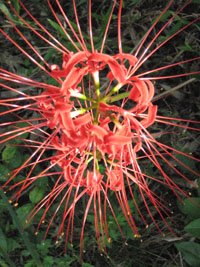
On a certain type of grass about a foot high, fine hairs held the dew in drops so small as to make them all seem a cottony vapor; patches of that grass stood out like glowing clouds of mist hovering in place just inches above the ground. Each type of grass I saw, each plant, coddled the dew in its own way: the clusters of spider lilies scattered along the roadside cupped the silver beads in the narrow curls of their glowing red blossoms, stringing others in evenly spaced crystal orbs along curving scarlet tendrils tipped with gold...

Though each of these individual plants was now existing for its first and only time, there in plain sight was the long knowledge that each of their line has gathered of early autumn in these parts, what is to be expected in this anciently recurring brief turn of weather, what to do with the happening, where and how-- to ensure that each drop of dew is separately held so it doesn't run lost to the ground but remains possessed, nestled, cradled, held close to vitalize seeds or evenly strung out like beads to wait their turn at nourishment, each of that whole mountainside of dewdrops holding in itself the sun, shimmering in that moment of down-mountain breeze from out of the darkness...

May we hold as closely the sunlit dews of our own lives...

Wednesday, September 27, 2006


EXPRESSING THE SENSE...


Shinzo Abe, now the Prime Minister, seeks to make Japan a more "normal country."

"Off to a fast start in setting up his Cabinet, Abe stocked the new government with conservatives on every issue from the economy and foreign affairs to defence and women's rights."

Closest to Abe in the new inner circle is Foreign Minister Taro Aso (whose family industrial dynasty's use of wartime slave labor he has never acknowledged)(funny how 'democracy' brings these people to the top), known for his hardline stance toward China.

It is said that much about Japan will change (revert?) as soon as Abe - democratically groomed for the Prime Minister's job since childhood - sets the stage for the new Japan by altering the world's only peace-affirming constitution so that Japan can have a "normal" army just like it had before and its restless neighbors can relax in the knowledge that all their worries have been well founded... Clearer friction: just what the world needs now.

"From today, I will start building a new Japan," says Abe. Maybe he and Aso could start off on both feet by responding to this army-related matter:

109TH CONGRESS
H. RES. 759
2D SESSION


"Expressing the sense of the House of Representatives that the Government of Japan should formally acknowledge and accept responsibility for its sexual enslavement of young women, known to the world as 'comfort women', during its colonial occupation of Asia and the Pacific Islands from the 1930s through the duration of World War II, and for other purposes."

Tuesday, September 26, 2006


WHAT DON'T THEY WANT US TO SEE?


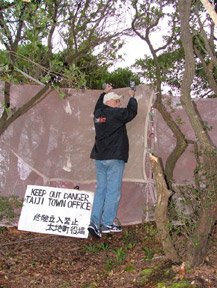
"Drive fishing, the method of killing the dolphins, is criticised as particularly cruel. Off the coast fishermen surround a pod (group) of dolphins. They lower long metal poles into the water and strike them to create a wall of sound that scares the dolphins and confuses their navigational skills. In Taiji, the dolphins are then driven into a shallow cove and a net across the mouth of the cove prevents escape. The next day the dolphins are herded into another cove away from prying eyes and camera lenses and are killed with knives or stabbed to death with spears. Japanese officials state that the dolphins die quickly and with minimum pain. NGO observers say the dolphins clearly suffer a prolonged, excruciating death. [In fact largely for use as pet food and fertilizer.]

Until a few years ago, the hunts were carried out in public. Now, due to increased interest, tarpaulins over and around the cove mask the killing, cliff paths overlooking the cove have been put out of bounds, and photographers are chased away...

Such incidents and the hunts in general rarely appear in the Japanese media..."


Further info:

Save Taiji Dolphins Campaign [What is being hidden]

One Voice

The Ecologist

With thanks to Jeff Bryant...


WILL THE NEXT ELECTION BE HACKED?


"...one muggy day in mid-August, Hood was surprised to see the
president of Diebold's election unit, Bob Urosevich, arrive in
Georgia from his headquarters in Texas. With the primaries looming,
Urosevich was personally distributing a 'patch,' a little piece of
software designed to correct glitches in the computer program. 'We
were told that it was intended to fix the clock in the system,
which it didn't do,' Hood says. 'The curious thing is the very
swift, covert way this was done.'

Georgia law mandates that any change made in voting machines be
certified by the state. But thanks to Cox's agreement with Diebold,
the company was essentially allowed to certify itself. 'It was an
unauthorized patch, and they were trying to keep it secret from the
state,' Hood told me. 'We were told not to talk to county personnel
about it. I received instructions directly from Urosevich. It was
very unusual that a president of the company would give an order
like that and be involved at that level.'"

By Robert F. Kennedy Jr.

As an aside, it will be interesting to see if gas prices fall until the November elections; then there's Karl Rove's 'October Surprise'...

Monday, September 25, 2006


CHERRY DREAMS


Late Saturday afternoon Mr. H. - the fellow who's been clearing the land above, as per my Monday post - stopped by to tell me he'd just cut the last of the trees he was going to cut on that land, he was now finished, and that I should go get whatever wood I wanted to take before the trucks came on Sunday afternoon to clear everything away.

I went up there asap early yesterday morning and found that in addition to some slim 'leggy' oaks, Mr. H. had cut a number of wild cherries, causing me all alone there in the forest to jump up in the air and click my heels, sort of a reflex action I exhibit upon seeing wild cherry logs for the taking, lying there in shining splendor right before my eyes.

So there I was again, chasing the deer away from their beds and for most of Sunday bucking, hauling and splitting logs to stack in front of the deck beside all the other wood I have to split for this and next winter, which I went on doing until the sunlight no longer served, then to dinner and bath and sleeping like those wild cherry logs out there.

Wild cherry is one of the finest firewoods there is; I know I keep saying that every time the subject comes up here, but it deserves saying each time, because each time I cut wild cherry it cuts so sweetly and fragrantly, and each time I carry it it smells so invitingly, and then there's the friendly musical tone it makes when tossed upon its fellows in the woodpile, and the even more beautiful note it makes when dry and ready to give back the heat of the sun in my stove, and the look of the wood itself, its heft and solidity, and then when it burns (and it burns well even when not fully dry) it gives off that fragrance again, burns hot and long right down to the finest ash-- wild cherry wood just, shall I say, knows exactly what it is doing in every respect.

Oh, and did I say that wild cherry wood splits as though it thought you'd never ask.

Saturday, September 23, 2006


O-HIGAN


Today is officially Shubun-no-hi, the autumnal equinox (also called O-higan or simply higan), brought first to mind for me (as usual) by earlier swathes of crimson higanbana (lit.: autumnal equinox flower; cluster amaryllis; spider lily) rising here and there on straight jade stems along the downmountain roadside (I saw the first one there 3 days ago; today they're blooming in my garden, 500 meters upmountain from there), and in cloudy red patches of eye-catching brushstrokes placed in random genius along the slopes of the just-shorn rice paddies, making the entire scene an astonishing work of art far bigger than the Louvre... But I never knew there were also white higanbana...

Such are the small but deep rewards of living just another day.

Wednesday, September 20, 2006


Jet full of lives
streaks its way to China
beneath uncountable galaxies

PICKING BLUEBERRIES ALONE


Having at last to notice by the sheer force of blueberry blue that the remaining clusters of berries are now ripe - I've sort of been avoiding the blueberry bushes because they remind me of hungry little hands reaching in to pick the ready berries only a few weeks ago, and of the delight it was to watch those faces light up at the first taste of blueberries fresh-picked with your own new hands - I am obliged to pick the berries with a bit of blue heartache, knowing how much the grandkids would have enjoyed plucking these plump blue jewels and chewing them up on the spot, their faces shining with blueberry light...

In my own older hands reaching in among the reddening leaves I see the new little hands reaching in, and as I chew the fresh berries on the spot I try to taste the blue richness with all the childhood I can muster, to see and feel and know it all new again, and I do-- I succeed, to my surprise; I return for the length of the taste to when I first savored new blueberries - it's all still there in me somewhere - and thanks to the grandchildren for that inspiration, though I'd still rather they were here to do it new.

Tuesday, September 19, 2006


LET'S HOPE IT'S THE PREPOSITION


"What does 'outrages upon human dignity mean?"'

If an apparently stable adult asked you that question in all seriousness, what would you think?

In fact, the question was asked recently by the President of the United States, during a press conference: "This debate is occurring because of the Supreme Court's ruling that said that we must conduct ourselves under the Common Article III of the Geneva Convention. And that Common Article III says that there will be no outrages upon human dignity. It's very vague. What does that mean, 'outrages upon human dignity'"?

I should think that the phrase would be perfectly clear to any emotionally capable adult who holds public office, but I have a dictionary, which defines an "outrage" as "an act of wanton violence; any gross violations of law or decency..." I'm not sure why that should be a problem for America's highest official, the phrase hasn't been a problem for any of the signatories to the Geneva Convention for over 40 years now; I think most of us would know when we were crossing that line.

So if he's got "outrage" clear in his head, then I really hope it's the preposition that's got him stumped, because I shudder to think that a sitting president of the world's only remaining superpower is having trouble grasping the meaning of "human dignity."

*

Monday, September 18, 2006


LIKE A LIVING STREAM

For the past few days a bulldozer has been clearing away the underbrush across the road, where the Baron has had his autumn/winter home for the past several years (he has a lot of other higher and lower places to live, so maybe he'll leave my biwa tree and winter spinach alone) and where resides the tall oak that helpfully cuts off my tv signal every spring and restores it every autumn so I can maintain an even perspective on society's progress and the relative importance of its communication through the tubular medium, which seemed to be severely wanting last time I looked. The bulldozer operator says the property is being cleared for sale, and he was not asked to cut any trees. It's only about to be put on the market. We were curious about the trees as firewood, since they would simply be treated as trash.

Purely coincidentally, when we got back from shopping yesterday we found a calling card in our mailbox, the card saying that the card-leaver, who lived down in the village, had some fresh-cut wood if we were interested. We phoned and he explained the wood's whereabouts, which happened to be a couple of roads further up on the mountain on a parcel of land he was clearing so as to expose the long-unused house there that had been overgrown by the forest, as someone was interested in the property. We went up and found the place on this morning's walk, and saw that a good bunch of slim beech had been cut.

Thus it was that toward dusk, after cleaning, gassing, oiling and sharpening the chainsaw I was alone up in the deep and even dimmer forest beneath a lowering sky already sparsing rain as the next hurricane quietly edged our way-- I wanted to get the logs bucked and out of there before everything got all wet and before the clearing fellow made his next cuts. He would appreciate my easing his task.

Surreality is lugging a chainsaw up a steep slope in dead-still oppressive air through silverized undergrowth in a silver forest bathed in the thick, silver light of pre-hurricane-charged dusk and finding downed trees only slightly more tarnished than the light; starting the saw to a roar in that static silence and begining to section the logs - the deer you heard plunging away at your approach now listening from just beyond the edge of sight - then the air never so static and silent as when you stop the saw and then hear the cling-clang-clong marimba sound of the wood falling upon itself as you throw it far down, closer to the van, before forcing a path through the thick bamboo, cut branches and vinery for your arms-full-of-wood self over and over again...

Good to let sweat run free, like a living stream...

Sunday, September 17, 2006


AS TO WORLD SOCIETAL EVOLUTION,


"A 24-year-old who had never worked in finance -- but had applied for a White House job -- was sent to reopen Baghdad's stock exchange. The daughter of a prominent neoconservative commentator and a recent graduate from an evangelical university for home-schooled children were tapped to manage Iraq's $13 billion budget, even though they didn't have a background in accounting. The decision to send the loyal and the willing instead of the best and the brightest is now regarded by many people involved in the 3 1/2 -year effort to stabilize and rebuild Iraq as one of the XXXX administration's gravest errors."

Only "one of the gravest errors."

Saturday, September 16, 2006


THE POINT OF EVOLUTION


The point of evolution, it seems to me waiting for the train in the morning rain, is not to get me to the office on time; nor does it seem to consist in my sitting at a desk all day, seeking ever higher income until I outgo.

In terms of the big picture, I mean the BIG picture, infinitely bigger than the largest font in any word processing software that will ever be created, there is of course no point at all to what we call evolution; it all merely IS (same unattainable font, only bolder). Locally speaking, however, necessarily whence I ramble, if there is a site-specific point to evolution it must be relevant to us humans right here and now, must it not, for if it isn't, then what's the point, is I guess the point.

Some say there's a heaven to which we'll go if we stick to one of the many creeds said to be worth dying/killing for; then we can be with goodness forever and/or 27 virgins (or raisins, depending on the reading), together with all our relatives and friends and everybody, but that doesn't seem like much of an incentive because although I would greatly look forward to meeting certain folks again, I'm not sure how many I'd want to spend forever with, or they with me. And there are so many costly yet oversold blisses along the way to that gate are there not, most of the best ones detrimental or even criminal, all of them short-term, a few decades at most. (I'm not being cynical; just roughly sketching the teleological big picture here.)

But then heaven on earth as it is in heaven is neither here nor there, for belief in anything written by an uncertain number of apochryphal anchorites is not necessarily the way to paradise, which is I suppose why each of the famously conflicting creeds came up with the buffer idea that god required multiple secretaries. There's a good chance that bacteria have a better belief system, with a more a propos heaven.

The point of evolution then, locally speaking as it seems to me, must be something much better than a heaven that can be flogged in a book, it must be a heaven (same font that surrounds the stars) in which there are native animals and plants, but no commuters, no managers, no received ideas, and where utter believers have been left behind.

There are a wealth of signs in this life that there is already a genuine, warm and welcoming heaven somewhere in ourselves, as we can see in our children and in the eyes of those we love, as we can feel in our own hearts at such moments, moments naturally free from the restraints of belief, moments that rise like a spring from the ground of our being.

The "lower" forms of life and non-life around us have not been vouchsafed the "privilege" of pondering these things, or of having the perks that go with such ponderance, i. e., higher salaries, ethical quandaries, pensions, mcmansions or lamentations of transience; they simply go about their lives, which must be heaven, and which is what I would like to do actually, even moreso than I'm doing right now on the train platform, but then the question for each becomes how, and what is a life and am I wasting mine or is it even mine, for a life as purely natural as those of the flora and fauna isn't available to homo sapiens, and perhaps never was; likely as not it went out the window when sapience burgled in with its sack of guilt and questions.

We blessed with this paradox have spent millennia trying to unravel it, or at least tie up the loose ends, coming up with all sorts of exclusive gordian knotways to bliss/illumination/paradise, of which the commuter train now pulling in is definitely not one. Before I board, just let me say that sure, all the prophets went into the wilderness, but they all came back out bearing tenets to die/kill for, which true believers are doing right and left even today. And look at what's happening to the wilderness.

One thing I'm sure of: truth will be victorious.

Thursday, September 14, 2006


JUST LEAVE THE WATER RUNNING


There's nothing wrong with longevity, if I have any left, but I've had a glimpse of the future and I'm not all that sure I want to be there when it arrives. It's looking way too virtual for an insistently palpable individual like myself. I've always liked face-to-face, hand-to-hand, cheek-to-cheek, even cheek-to-jowl, if that's all there is. But what they're planning for us elders, elderlings and those who will follow is cold, metallic and wireless, with all the emotional warmth of a silicon chip.

They're already well along in developing robot caregivers (might as well use a bespoke forklift), but you really get the sense that the old ways are fading, the old meanings falling silent, the old values losing their luster, when you read a newspaper article like the one I link to below.

Not that I myself am ever going to be conned into such a situation, mind you (no way; I'll circumnavigate the earth in a canoe first), but the fact of the steady distancing between the generations and what that portends, the growing desensitization regarding the issue of ignoring your elders to as impersonal a level as possible, already has me polishing my paddles...

The market researchers are so sure of the social outcome that government and corporations are already TURNING ELDER-ISOLATION INTO A MARKETING PLOY! (Remember, Japan is the developed world's coalmine canary):

"The Tokyo metropolitan government's Waterworks Bureau is to offer a new service enabling families who live apart from their elderly parents to check on them, by sending relatives daily e-mails with details of the volume of water their parents have used...

Such a security service has already been introduced for gas consumption and some models of electric kettles..." In other words, the water company et al. will belatedly update you on the survival status of your forebears.

As for we free-range elders (like I said, if a public utility is ever my go-between, I'm outta here), when it reaches that point I'll open the taps, turn on the gas, plug in my electric kettle and launch my canoe. Anyone else who's interested, let's meet on some pre-arranged tropical islands and start our own government: World Elder Restoration Of Classy Karma.

THE NATIONAL BIRD


Most nations have a national bird, it's just a thing nations do, they have national flowers and trees and even fish I suppose, though none have a national vegetable or appliance, there are limits to these things.

Japan's national bird is the pheasant. The bird is on the money. The pheasant is described as "characterised by strong sexual dimorphism, with males being highly ornate with bright colours and adornments such as wattles and long tails. They are usually larger than the females. Males play no part in rearing the young." I wouldn’t have minded being a
cultural fly on the wall when that choice was made.

Other nations have made interesting choices for national bird too; Australia, for example, chose the Emu-- rather hastily one suspects. Canada opted for the common loon, which many see as unfortunate; Egypt hasn't even bothered to select a national bird, since they have the pyramids and the sphinx; nor has China gone the bird route, what with Mao and the Great Wall; the French bird is the rooster, which is somehow a propos...

I doubt, though, that any of these selections involved such heartfelt parliamentarian pleas for various avian candidates as there were back when America chose its bird: not Franklin's turkey, heaven forfend, but Jefferson's favorite, the bald eagle-- which, though photogenic, maybe wasn't all that good a choice.

Anyway, my vote goes to Charlie Parker.

Wednesday, September 13, 2006


THE BIG CONVERSATION


One summer evening not long ago in a certain part of Tokyo, a big city up north, hundreds of households right at the pinnacle of prime time were suddenly plunged into an unfamiliar state known in pre-electric times as "utter darkness."

Workmen were sent out at once to bring back the light. After searching fruitlessly for the usual technological glitch, the workmen broadened their horizons and discovered a large, well-done eel stretched across some high-tension lines, shorting them out. It was concluded that the eel had been dropped on the wires by a fishing hawk. The workmen removed the eel, the power came back on and all was resolved. Or so the reporters seem to think.

But something whispering from where the ancient ones live tells me that, given the symbolic and mythological history of hawks and eels, there is more to this event than merely modern reportage would have us believe. Some almost forgotten kind of paleoreportage is needed, that considers the opinions of nature, heeds the voices of hawks and eels.

Nature is never mute, whether we're listening or not. And as with the occasional nuclear reactor blowout, the widening ozone holes over the ends of the earth, the barely measurable rises in sea level or the growing numbers of increasingly powerful hurricanes, the hawk-eel conspiracy was, I suspect, another of nature's many local attempts to tell us something we've forgotten how to hear.

Nature has always been advising us, but we haven't paid much attention since we entered prime time; and natural advice rendered in hawk-and-eel syntax is hard to grasp nowadays, when so many are deaf to what remains of the wild. But hawks have aboriginally been respected as sky-high visionaries and spirit guides; and eels, mythologically ever at the bottom of it all, are no strangers to high voltage.

Our own bodies as well, urbane as they've become, have always run on electrical power, though for millions of years we were in the dark about that; we only discovered electricity a few millennia ago, named it after amber and are still fiddling with the knobs, don't understand it, anybody seen the remote?

Maybe the hawk gave up its meal to say don't forget the darkness, if you want to know the light. Maybe the eel surrendered its life to remind us not to treat power like a slave, if we want to be free. Maybe nature was saying rejoin the big conversation out there, before the father of all hawks drops the mother of all eels.

Or maybe it meant no more than anything else does.

Tuesday, September 12, 2006


LIFE GOES ON, AFTER A FASHION...


"I won't pee in your
COTTON

if you don't
OIL

in my boston"

--t-shirt I just saw on the train