We have roots
we branch out
we blossom
we bear fruit
like trees
what lives
we are!
 The typhoon cutely named Shanshan, that was supposed to roll playfully northward at a harmless distance from Japan's Pacific coast like a meteorological panda cub, turned out to be a sky-sized Clydesdale that for much of the night put its big shoulder against our house and pushed the kind of push that makes you hunch up your shoulders and squint your eyes in expectation of a wall giving way.
 On rainy Sunday we thought we'd go to some other kind of world than the one in the headshaking news, so we went to where everyone was smiling even in the rain, where kids played freely, where everywhere we looked was beauty and simplicity. We did this by driving north for about 45 minutes to a mountain village called Hata that we hadn't even known existed until we heard about its festival via the local grapevine.
 1000 years ago. Hata is one of those villages in central Japan that were created back then in locations chosen for their remoteness. They were established by ochimusha (defeated warriors) in the aftermath of the great climactic battle of Dan-no-Ura, chronicled in the Heike Monogatari (The Tale of the Heike). Following disastrous defeat, surviving Taira clan warriors, their families and other battle stragglers fled for their lives to distant, hidden places that they'd known about here and there in central Japan - and likely had kept in mind in case of just such an eventuality - unsettled mountain fastnesses where they would not be found and hunted down, and where their descendants live still.
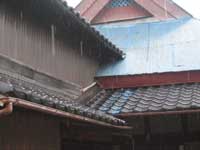 The road into the village, now a single-lane paved road along a stream between two mountain shoulders, was originally only the stream through a steep defile, the well-hidden village therefore easily defensible by only a few against an army. And so they've lived there for nearly a millennium now, along upward winding roads lined with old and new farmhouses flanked by rice paddies terraced along the natural topography, the tall trees and mountain ridges shaded into distances by the rain and mist…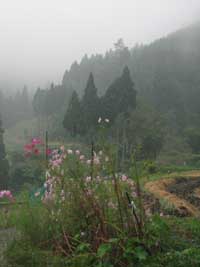
Stem-cell banks, telomerase amplifiers, somatic gene therapy—the list of potential longevity treatments incubating in laboratories is startling. Three years ago a multi-institutional scientific team led by Aubrey de Grey, a theoretical geneticist at Cambridge University, argued in a widely noted paper that the first steps toward 'engineered negligible senescence'—a rough-and-ready version of immortality—would have 'a good chance of success in mice within ten years.' The same techniques, De Grey says, should be ready for human beings a decade or so later. 'In ten years we'll have a pill that will give you twenty years,' says Leonard Guarente, a professor of biology at MIT. 'And then there'll be another pill after that. The first hundred-and-fifty-year-old may have already been born.'
Even this relatively slow rate of increase, he says, will radically alter the underpinnings of human existence. 'Pushing the outer limits of lifespan' will force the world to confront a situation no society has ever faced before: an acute shortage of dead people."
I don't know about you, but I'm ready to wield some collective wisdom.
 Last summer in my hurry before leaving for the states I sectioned and stacked a half-cord of oak where it was most convenient at the time, beneath the plum tree, and obverse to the prevailing wind. As a result the wood couldn't dry adequately, so the wood beetles and fungus-cultivating ants renovated it into an insectivoral Beverly Hills Grand Hotel. In further consequence, this morning I was out early continuing the task of stripping the damp bark off the sections under the watchful eyes of butterflies, dragonflies, a frog in his niche in the deck joinery, and Dr. Crow, who was up in the chestnut tree burbling over the prospect. He knows that whenever I do this I uncover handfuls of fat white wood-beetle larvae, some the size of Wichetty grubs, that dine on the oak cambium layer and into the wood itself, and when exposed just fall to the ground and lay there invitingly, like crow antipasto.
 Shinzo Abe, now the Prime Minister, seeks to make Japan a more "normal country."
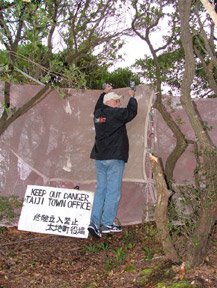 "Drive fishing, the method of killing the dolphins, is criticised as particularly cruel. Off the coast fishermen surround a pod (group) of dolphins. They lower long metal poles into the water and strike them to create a wall of sound that scares the dolphins and confuses their navigational skills. In Taiji, the dolphins are then driven into a shallow cove and a net across the mouth of the cove prevents escape. The next day the dolphins are herded into another cove away from prying eyes and camera lenses and are killed with knives or stabbed to death with spears. Japanese officials state that the dolphins die quickly and with minimum pain. NGO observers say the dolphins clearly suffer a prolonged, excruciating death. [In fact largely for use as pet food and fertilizer.]
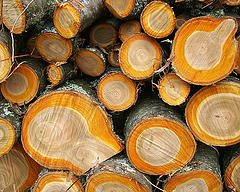 Late Saturday afternoon Mr. H. - the fellow who's been clearing the land above, as per my Monday post - stopped by to tell me he'd just cut the last of the trees he was going to cut on that land, he was now finished, and that I should go get whatever wood I wanted to take before the trucks came on Sunday afternoon to clear everything away.
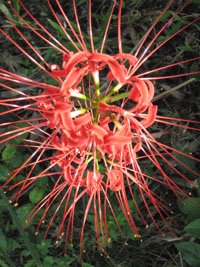 Today is officially Shubun-no-hi, the autumnal equinox (also called O-higan or simply higan), brought first to mind for me (as usual) by earlier swathes of crimson higanbana (lit.: autumnal equinox flower; cluster amaryllis; spider lily) rising here and there on straight jade stems along the downmountain roadside (I saw the first one there 3 days ago; today they're blooming in my garden, 500
 meters upmountain from there), and in cloudy red patches of eye-catching brushstrokes placed in random genius along the slopes of the just-shorn rice paddies, making the entire scene an astonishing work of art far bigger than the Louvre... But I never knew there were also white higanbana...
 Having at last to notice by the sheer force of blueberry blue that the remaining clusters of berries are now ripe - I've sort of been avoiding the blueberry bushes because they remind me of hungry little hands reaching in to pick the ready berries only a few weeks ago, and of the delight it was to watch those faces light up at the first taste of blueberries fresh-picked with your own new hands - I am obliged to pick the berries with a bit of blue heartache, knowing how much the grandkids would have enjoyed plucking these plump blue jewels and chewing them up on the spot, their faces shining with blueberry light...