Friday, March 03, 2006
WHERE DO YOU GO IF YOU DON'T NEED A LOAN?
Here's an oriental enigma for you; the subway poster for this company had me pondering what could this mean? for hours. What kind of service could they possibly be offering? Is this where you go if you absolutely do not need to borrow any money? You walk in and say "I don't need a loan," and they say "OK, thanks for using our service. Have a nice day!"? And on the other hand, would this be the kind of place you'd go to (or name you'd look for) if you DID want a loan? Keech explained it to me a few days later, but I still can't get my mind around the name


Thursday, March 02, 2006
THE INALIENABLE RIGHT TO FLUFFY
Of course the pet-threat was big on Thomas Jeffersons' mind; he knew first hand the pain of pet confiscation by tyrannical governments, when the heartless redcoats snatched his favorite frog, Croaky.
The right to own and raise pets was clearly as crucial to the author of the Declaration of Independence as it had become to George Washington, father of the entire country and all its pets, when he was still a kid and the British confiscated his kitten Fluffy.
Then of course there was Benjamin Franklin's purloined darling chihuahua Poquito, Tom Paine's nameless tarantula, taken away in the dead of night without a warrant, James Madison's commandeered turtle collection, John Adams' requisitioned hamsters – indeed, the true and impassioned history of tyrannized founding pets has yet to be fully fathomed.
The personal grief of pet appropriation by governmental tyranny was a big reason why America's founding fathers, as soon as they got together to discuss pet protection, saw right off that they needed a constitution, and that its fundamental provisions should start with the right to own and raise any pets they wanted to. And then maybe freedom of whatever and the right to do other stuff. Understandably, in their eagerness to ensure the inalienability of pet ownership, they forgot about the right to a decent education.
Wednesday, March 01, 2006
SOUNDS LIKE MONDAY
You know that kind of day, when another universe or something impinges on the one you were sure you were inhabiting - it seems to happen most often on Mondays, when all at once there's an alien galaxy passing through my life - well some scientists have come up with a hypothesis that sounds about why to me. They haven't consulted me, so they still think it hasn't actually happened yet, though I'm in no rush to go into details.
"Our universe may one day be obliterated or assimilated by a larger universe, according to a controversial new analysis. The work suggests the parallel universes proposed by some quantum theorists may not actually be parallel but could interact – and with disastrous consequences."
Sounds like Monday to me.
WORDS OF A KAMIKAZE SURVIVOR
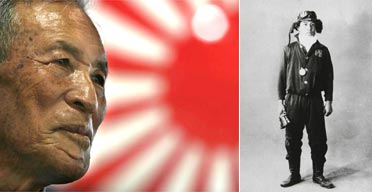 "He has little time for the notion that the young men who flew into enemy warships did so happily in a selfless display of loyalty for the emperor.
'We said what we supposed to say about the emperor, but we didn't feel it in our hearts,' he said. 'We were ready to die, but for our families and for Japan. We thought people who talked seriously about wanting to die for the emperor were misguided.
"It was more like a mother who drops everything when her child needs her. That's how the kamikaze felt about their country.'"
'We were ready to die for Japan'
Tuesday, February 28, 2006
THE RICH DO INDEED!
Seems I left the career track just in time...
"Between 1972 and 2001 the wage and salary income of Americans at the 90th percentile of the income distribution rose only 34 percent, or about 1 percent per year. So being in the top 10 percent of the income distribution, like being a college graduate, wasn't a ticket to big income gains.
But income at the 99th percentile rose 87 percent; income at the 99.9th percentile rose 181 percent; and income at the 99.99th percentile rose 497 percent. No, that's not a misprint...
Both history and modern experience tell us that highly unequal societies also tend to be highly corrupt. There's an arrow of causation that runs from diverging income trends to Jack Abramoff and the K Street project."
Interesting, that a discerning democracy elected one born into the 99.99th percentile to be its fair and balanced leader...
TWIGS ON THE TREE OF LIFE
Freewheeling down the road this early morning after scraping the frost from my motorcycle, right around the third curve I came upon two aimless adolescent monkeys just hangin' out, fresh from the forest and looking for trouble, standing there at the roadside like teenagers do. Lolling idly on the streetcorner completely unsupervised, nothing to do, no job, no elders teaching them anything about bettering themselves and making something of their lives, other than just climbing fences or dangling from trees and saucily ogling passersby on motorcycles, maybe there's a garden around here we can raid, teenagers are the same everywhere. Fresh from the forest we all go through those phases, one way or another. I used to be one of those guys, but I managed to get out of my tree. They're probably checking my garden out right now, but I got all the shiitake yesterday. Nothing like a bit of education.
Monday, February 27, 2006
KAMIKAZE DRIVING
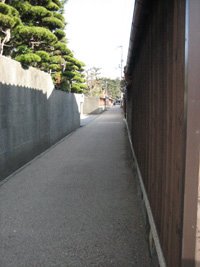 It was in Okinawa, back in the early sixties, that I first experienced what was there called by we foreign visitors "kamikaze driving." Many of the streets there, as here in Japan even now, were originally formed for a couple of lightly laden people who kept their arms to their sides, or maybe a small horse cart to pass by.
Most of those streets still exist in the major cities here, threading between the large thoroughfares of modern day. In the countryside there are no thoroughfares of modern day to speak of, other than those bypassing small towns to get to the major cities.
Major highways, other than the national expressways, are mostly narrow two-laners; the remaining local roads are the old horse tracks. In a taxi speeding down one of those, if you opened your door even a crack you'd hit a telephone pole or an elderly stroller; if you dared reach out your arm, you could steal an apple or knock someone off a bicycle.
After a while of driving here you get used to it though; if you meet another car coming the other way on a one-car-wide road, one of you (as determined by a complex formula of driver courtesy) pulls over into one of the mini-pullofs strategically located for the purpose. I say strategically, for there is a transcendent system to driving in Japan, a system put in place by one of the founding gods, probably Susano-O-No-Mikoto, if I know my deities.
But as a newly arrived foreigner not yet familiar with the trafficking ways of Japanese gods, you're not yet a fluid traffic element, so don't hit these mini-pulloffs with the necessary surrhythm so as to advance readily to your destination. By the time you've been driving here for a year or two though, if you're still in one piece and your license hasn't been revoked, you are mystically accepted into the national driving rhythm, and miraculously meet other cars only when there is such a pulloff handy.
It is quite an amazing thing, which on the first couple of occasions you chalk up to Western coincidence; soon, however, you realize that 50 out of 50 is against the odds of any crapshoot you've ever experienced; that's when it dawns on you that somehow you have fully merged with the national driving program. From that point on, you too are a kamikaze driver, and can speed blithely down streets not much bigger than the corridors of your house, quickly spotting bicyclists emerging from behind telephone poles and vegetable-laden elders stepping out of their doorways, without feeling even a tinge of alarm; they too are part of the rhythm.
So in all my 20 years of driving in Japan I haven't hit a single elderly person or other pedestrian, not even a bicyclist, though I have tapped mirrors with other cars on occasion, in sort of a hail-fellow-well-met kind of gesture. I suppose that if as a visitor you were a passenger on one of my kamikaze outings, you'd put fingernail marks in the dashboard, but no need to worry; we'll get there in one piece, unless maybe we run into a new a foreigner coming the other way.
Sunday, February 26, 2006
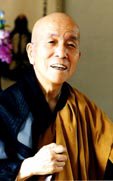
NEW BLOG BY ZEN MASTER GUDO NISHIJIMA
"My name is Gudo Wafu Nishijima, a Buddist Monk, who is 86 years old, and recently because of my old age, I finished my Buddhist lectures, which were held at many places for many years, and so I decided to open Dogen Sangha Blog, to express the Buddhist thought. It might be very short sentences, but I would like to continue it as far as possible almost every day."
SOMETIMES YOU JUST GOTTA WALK ON FIRE
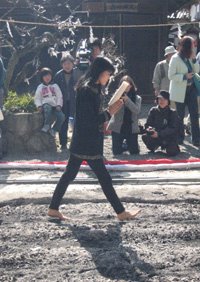 If you know Echo, you know she just had to walk on fire again. She married me, after all. So off we went yesterday morning to Sugawara Jinja so she could walk on some more fire.
You may remember our earlier quest for the renowned firewalking shrine event that it seemed no one had ever heard of, well this time was much the same, even though we'd been there before. It just seems to be a uniquely located location. This time we left the house at 10:40; the event started at 11, we figured maybe if we hurried we'd find it. Didn't work.
Before we'd been lost too long (we knew definitely that the shrine was somewhere within an uncertain number of kilometers from wherever we were) we drove to a train station that was rumored to be in the shrine's vicinity and checked the big local map posted in front of the station, spotted the little red dot that indicated Sugawara Jinja and drove there right away in the wrong direction. A word here about the big maps they put in front of train stations in Japan: those maps are made by local people, who already know where everything is. They don't need a map, and they expect pretty much the same of you. It is simply a polite invitation to get to know the place by direct experience.
So we wound up in a small alley street somewhere and asked a group of local elders, who were standing there chatting, where Sugawara Jinja was. Much hissing and musing issued at once from the group, till at last one of the men said basically, eyebrows rising: "If you want to go to Sugawara Jinja, why are you all the way over here?" An elder woman then gasped in astonishment: "Why, that's way over in Ebe!" (We had been looking for Ebe all along, but each place appears to have only one small place-name sign, which is kept in the mayor's office.
By a thoroughgoing process of elimination, we finally blundered into Sugawara Jinja via one of the infinite directions in which it lies, just as the priests were preparing the ashes for all the feet. Only 160 people would be issued the certificates enabling them to sear their soles; Echo got in at #159.
The firewalkers young and elder were hopping over the air-shimmering embers as they walked, but Echo said it wasn't nearly as hot as last year. She also walked the fire at a shrine near here not long ago, so I suppose you get used to it. Anyway it's easier than finding Sugawara Jinja.
Saturday, February 25, 2006
BOY, DID JAPAN NEED THAT!
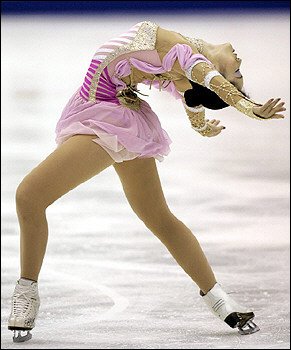 The big news today in Japan, eclipsing even the multifaceted Livedoor scandal, is the news of Shizuka Arakawa's winning the gold medal for figure skating in Torino, Japan's only medal for this Winter Oympics.
Yesterday morning at all the big train stations here in Japan, all the newspapers were handing out free copies of the story to commuters, who then stopped rushing to work and just stood there reading. It even stopped commuters! After all the bad news that's been oppressing the national mood, it was a very welcome uplift. Even Koizumi smiled an apolitical smile.
Life-sized Arakawa cutouts were on every news program, her performance was replayed over and over, the scene always cutting to her parents watching her in the stadium, then to relatives and local residents of her hometown watching her performance from local halls, all breaking into screams and tears of joy at the successful climax of her free skating routine... intercut with old documentary footage about Arakawa's skating history, how her mother had made all these outfits for her daughter over the years since she started skating at the age of 5, boxes of worn out skates (her mother couldn't throw any of it away), how two years ago Shizuka had decided to quit skating and had worked at a convenience store until, at the urging of her parents and coach to try for just one more year, maybe even make the Olympics, at last she decided to skate until she could perhaps achieve one perfect performance.
She did that at the Olympics, when it counted. I noticed that midway through her routine she broke into a smile for herself; she knew right then that she had it nailed. What a thrill it all is for Japan.
Interviewed on tv later, with her gold medal about her neck, she said she stayed calm by not watching the other skaters perform and not listening to their music, and by thinking of the ice cream and pleasant coffees she'd enjoyed in Torino...
She'll have a very different normal life now.
Friday, February 24, 2006
CULTURAL HUBRIS?
As countless tv ads indicate daily, the Japanese study English by the millions (like so many other people around the globe), but compared to other Asian countries, they seem to have little success at it. (Yesterday I saw a document in English from one of the Japanese Government Ministries and the English was a national embarrassment!)
The why of all this has always been somewhat of a mystery. Even well-educated Japanese are rarely fluent in English, which is a surprise to many, especially Americans. The US, though much more of a melting pot, also has never been much of a linguistic contender globally, preferring to coast on linguistic privilege. But monolinguists in English no longer have the global edge they once had. And many US states don't even have a HS language requirement anymore!
As if that weren't bad enough, at the US State Department, only 10 of 34,000 employees are rated fully fluent in Arabic! Right now!
I see a new world composition coming.
Thursday, February 23, 2006
I SURE HOPE THEY'RE WRONG,
But just in case they're not, this might give you some time to get ready...
"The Laboratoire Européen d’Anticipation Politique Europe 2020 (LEAP/E2020) now estimates to over 80% the probability that the week of March 20-26, 2006 will be the beginning of the most significant political crisis the world has known since the Fall of the Iron Curtain in 1989, together with an economic and financial crisis of a scope comparable with that of 1929. This last week of March 2006 will be the turning-point of a number of critical developments, resulting in an acceleration of all the factors leading to a major crisis, disregard any American or Israeli military intervention against Iran. In case such an intervention is conducted, the probability of a major crisis to start rises up to 100%, according to LEAP/E2020.
The announcement of this crisis results from the analysis of decisions taken by the two key-actors of the main on-going international crisis, i.e. the United States and Iran:
-- On the one hand there is the Iranian decision of opening the first oil bourse priced in Euros [see what happened to Saddam when he tried it...] on March 20, 2006 in Teheran, available to all oil producers of the region;
-- On the other hand, there is the decision of the American Federal Reserve to stop publishing M3 figures (the most reliable indicator on the amount of dollars circulating in the world) from March 23, 2006 onward.
These two decisions constitute altogether the indicators, the causes and the consequences of the historical transition in progress between the order created after World War II and the new international equilibrium in gestation since the collapse of the USSR. Their magnitude as much as their simultaneity will catalyse all the tensions, weaknesses and imbalances accumulated since more than a decade throughout the international system."
Full article
Excellent analysis of the situation here
Wednesday, February 22, 2006
IN THE TEMPLE OF THE MORNING AIR
As I've indicated a number of times in these lowly chronicles, I'm not a big fan of camphor as firewood. (I'm sure this is very valuable information for all you woodheaters abroad.) I got hold of an entire camphorwood log last summer and spent many stubborn sweaty hours trying to split a couple of bucked sections by hand and gave up on the rest of it; camphor wood is way more stubborn than I am. So now I use the remaining sections for various other purposes in the garden. The wood is light but never decays; even bacteria seem to dislike it. Which I suppose is why it's a primary ingredient in Tiger Balm, and that old standby of my childhood, Vicks' Vaporub.
I did however get some split chunks of the wood in a half cord I recently bought from my local wood dealer to tide us over for these few remaining weeks of cold weather, since all the wood I split last summer won't be ready till the coming winter.
So this cold foggy morning, after I got the stove going good I went to the woodpile and got a big chunk of camphor wood that the dealer had split with a power splitter; I could tell by the broadly ragged edges and the splintered nature of the chunk that even with a power splitter the camphor had put up a hell of a fight, light as the wood is. Indeed, it looked as though it was still reaching out for the rest of itself, even now trying to hold all together. I arranged it in the stove with some other "hotter" wood (camphor burns rather fast and not very hot, like pine wood) and had breakfast.
Later I went out into the still-hanging mist to get some greens from the garden and noticed a very pleasant scent on the pearlescent air, though nothing was blooming yet; I even checked the jinchoge (myrtle), which is due to blossom pretty soon. The scent was vaguely familiar though, sort of like... camphor, but not, exactly... Then it became apparent that I was smelling the chimney smoke that was being held to the earth by the mist; it was the camphor wood burning, its diluted scent now perfuming the mist like a rare incense, turning all the air into a temple.
Camphor wood does have its worshipful aspects.
Tuesday, February 21, 2006
MORNING NOSTALGIA SHOCK
This morning I experienced an odd bit of nostalgia shock when I saw a woman in the city carrying her infant in the old-fashioned way. It was all the more surprising for the additional fact that it has become rather unusual even to see Japanese women with newborns anymore. The mother was using one of the baby slings that were so common when I first came to Japan (and a version of which I myself used on occasion when our children were born), but that sadly have pretty much disappeared, as this sight reminded me. The mother was carrying the infant strapped to her front, facing her.
To accommodate all the added bulk, she was wearing a modern-fashion version of the thick oversized winter coat designed for the purpose (though I liked the old-fashioned ethnic designs better), the safely contained baby peering out from between the lapels at the new but cold morning world from the comfort of her mother's touch and warmth.
The sight used to seem so third-world-y (and was so common) when I first came to this country, fresh from the land of baby carriages that were even then beginning to resemble small wingless 747s, and beheld Japanese mothers everywhere with babies simply strapped right to their front or back and going about their tasks freehanded, the babies sharing in it all and watching every move, staring directly into the faces on the bus.
Having used both methods myself, I'll take the baby sling. It does two bodies good.
Monday, February 20, 2006
THE FUTURE OF DREAMS
Yesterday while out on one of our excursions we went to look at a piece of mountainside land we'd thought about buying 10 years ago when we were looking for the land we finally bought.
It was the same road as back then, but like so many of memory's roads, it didn't lead to the same place anymore; it led instead to another mystery. As the road wound up the mountain, it took us past a very large structure of stone on a small plateau shelving off the mountainside. I pulled over and got out to look at it more closely.
At first I took it to be the ruins of a castle, but a little more thought soon did away with that surmise: the mountain loomed up behind it; bad location for a castle. On closer examination it resembled an ancient tumulus, now very derelict from centuries (millennia?) of weather and tremor...
The site had clearly become a very popular dumping ground for free disposal of the many things one has to pay a fee to dump nowadays, all tossed into what looks to have been a sort of moat around the structure (moats are frequently characteristic of ancient tumuli here)...
The structure itself comprised very large stones (about half the size of our van), all fairly tumbledown, apart from the still intact high facet that had caught my eye. Another odd thing was that there were no historical signs around as to what the structure might be, nor were there any signs of archaeological excavation, all the more intriguing because as far as I know there's nothing very historical on the mountainsides this far north along the western shore of the Lake; most of the big-time history took place along the eastern shore (e. g., Nobunaga’s Castle) or further south on this shore. As well, this location was inconveniently high up on the mountain, with nothing else around; why all the way up here?
Whenever I see such mysterious ruins, where humanity past is speaking a time-transcendant form of language to humanity present, my temporary existence is filled with a sense of eternity at perceiving the true vastness of human time, at knowing that so long ago hundreds or thousands of workers sweated and strained, as with these stones, to build a structure to honor someone they revered or obeyed with a purpose that filled - even transcended - their own lives, and now all that remains of their efforts is the whisper of fallen stones in the wind, the disparate blending of honor and folly in anonymity...
Are we ourselves today any different, in our ambitions? Does the same fate await our own highest dreams, will they too one day serve merely as a place for folks to abandon whatever the future equivalent may be of pickup trucks and tvs, refrigerators and teapots, stereos and bedsprings?
Here's hoping we make it further than that...
Sunday, February 19, 2006
THE ROAD AT THE END OF THE RUT
Very often of late in my various Japanese bureaucratic editings having to do with Japanese society I come across worrisome phrases like "the growing proportion of elderly," "the increasingly aging society" and suchlike catchall concepts by which millions of persons and their collective wisdom are bundled together anonymously like a big social tumor or something.
Twenty years ago I didn't take much notice of such phrases because I wasn't in the elder group yet (if ever I would be); but now that I am, I find these socially fretful cliches patronizing, as if we silver foxes were all a big unwonted burden - perhaps even an imminent coronary in the body public - when in fact we are the wiser part of the public heart, the experienced portion of the social brain.
Among the many 60-pluses there are of course individuals who all their lives have always done what they were instructed to do and taken the paths they were directed to take, following their lives like a rut in the road: it may very well be that for their portion of the aging society there are cataractous and sclerotic times ahead: what happens when after a monodimensional lifetime your rut runs out into a multiplicity of dimensions, requiring a rennaissance history of diverse perceptions and multifaceted actions?
What happens when in your latter years you realize that you've spent all your life following the dictates of phantom uberfolks who had no idea who you really were or what you really loved (nor did they care), that perhaps you'd even had to be told what to be and what to want: could there be a greater disappointment than such a discovery at the end of the rut? What greater mockery than that open road flaunting its freedom now, after all these decades? It's that kind of person who frets about the "the increasingly aging society" and "the growing proportion of elderly."
As for the rest of us elders and wisers, we can take care of ourselves, the way we have all our lives; the road has taught us how.
Saturday, February 18, 2006
Friday, February 17, 2006
RIGHT BACK IN STYLE
As one of the founders - indeed pioneers - of the grunge movement as an undergrowth of the hippie style, owing to my growing personal conviction that clothing is not much beyond utilitarian (I had my fill of the alternative in 10 years of fashion modeling) I sort of naturally segued into wearing only jeans, T’s or western snap-button shirts and cowboy boots (for warmth, safety, convenience, universality (forest/garden/office), durability, price, you name it.
But now I see that because of a movie the cowboy look is back: shirts worn in Brokeback Mountain are auctioning at record prices.
The mountain I live on isn’t Brokeback, but just like when grunge came around I’m right at the front lines of style again!
What am I gonna wear now?

Thursday, February 16, 2006
Subscribe to:
Posts (Atom)