Showing posts with label tradition. Show all posts

Sunday, March 16, 2014


ONCE THERE WERE DRAGONS

As I was passing through a lakeside village yesterday morning on my way south, I saw a young fellow in a traditional men's kimono, calling into the doorway of a house. He caught my eye not only because of the kimono in everyday public on a daily street, but also because he was wearing a non-traditional backpack that was red and shiny - like some of the newer ones are these days - but oddly shaped, from what I could see.

Then he turned and began dancing, right there on the otherwise empty sidewalk, on the empty street of the Saturday morning village, his hands waving about in the prescribed manner of Japanese folk dance, and as he turned and turned I could see that the red part of the ‘backpack’ was in fact the stylized head of a red dragon; the lower part was a soft, truncated representation of the scaly dragon body. Then a drum and flute sounded, as his two accompanists - a minimal crew, also in kimono - emerged from behind the tall hedge and the trio began to perform.

Apparently they were going through the village in the new fashion, stopping only at households that opened to them and exorcising the demons there, of the kind to be found in every household in the world, if truth be told - and in many countries there are just the dragons needed to resolve the matter - but local public interest in demon rousting appears to be reaching new lows; just enough is budgeted now to satisfy the few elder residents who remember the old days, and still demand dragons.

This was the remnant of what once was a feisty village festival, in which a full-bodied, multi-citizened, demon-snapping dragon went whirling through the crowded streets from house to house of open doors, purifying each home with snapping jaws and writhing dance to many drums and flutes, creating strong memories of confidence in the little kids and reinforcing family solidarity against the demons that ever abide...

Now it is but a vestige, like the dragon's tail... like the dragon himself, who may soon be gone; there have been signs of dragon deficiency...

Where will time take us, when the dragons are no more?


Tuesday, March 04, 2014


Kyoto Journal issue #79 
- An Unfamiliar Home
is now out!

 #79 is out! 
Includes selections from Pure Land Mountain; 

Friday, August 16, 2013

Never Forgotten


The Days of the Dead (Obon) are with us again, as are the dead themselves, the beloved dead, and its good to have them around in spirit, visit their graves, pour water over the stones to cleanse the weathering of the past year, then give the beloved some of their favorite life snacks, leave a sip or two of sake, everyone so busy at these nationwide spiritual tasks during this time of year that once all have returned to their own home towns and their own home graves, the trains are empty. 

I get on in the morning and there are only 3 of us in the car; the streets are 'empty,' the offices too. Nothing much gets done there except the dead-end stuff, finalizing all the done-deals. Apart from the many renowned and WOWy firework shows and the lively nighttime Obon dance, it's quiet everywhere, as though we're getting a taste of death itself, which is a good thing for the living to experience every year, a few-day span of focusing beyond what we know; that's part of life too, after all, that soft wall. 

Living is dying and vice-versa, we can't really draw a precise line between them; sure, we pretend to, we have various stages and levels, phases and definitions - legal, medical, common sense - but we don't really know of a true beginning or end to any of it, the reason for our ignorance in this regard being simply that we haven't sufficient perspective in our merely living lives; we can only weigh what we can prove. 

This what we living conjure up, returning once more to the Days of the Dead: not just the memories of the beloved-- how they lived, what they looked like, their personalities, good and bad points, how they talked, what they spoke of, what they valued, their strengths and weaknesses... We do all that as in a mirror of memories, seeking a glimpse beyond into what must be the truth of it, but that is not vouchsafed to us in the special narrowness of being alive; we must wait to learn what is not forgotten...     


Friday, April 16, 2010


SIMPLE THINGS


One of the deeper powers of the Japanese people is their undying love of simple things. They come from a long and concentrated past, uncolonized, and have willingly adopted all the diversions and distractions that the modern world has to offer, from trains, cars and planes to movies, tv, fast food, computers - it's a long list - and they enjoy and use it all, even improve on much of it, but at the core they're still much the way they were before all that came along.

I saw a good example of this the other morning when Echo and I joined the crowds going up the cherry blossom-lined mountain road not far from our house, to the cherry-inundated ski ropeway area where locals throng during cherry season to picnic and view the Lake, visit the stalls at the local product hall, buy some local foods and wines, pickles, sake, senbei, shochu, sit around on the red cloth-covered platforms and enjoy the events, some singers, some taiko drummers and other performances out in the open air.

All are just getting into enjoying their picnic bento when the MC announces that the mochi-making will now begin and whhhooooosssshhh: instantly all the platforms are empty and there is a steadily growing crowd of folks of every age gathered around the mochi-making place to watch an event that everybody there has seen dozens, hundreds, thousands of times (Echo is up there too watching, but for me a few dozen viewings is pretty much enough): someone plops a hefty hunk of hot glutinous rice into a big wooden or stone mortar and someone else pounds it with a big wooden hammer as the first someone, after each hammerstrike, with wet hands turns the blob of increasingly sticky rice, the crowd yelling at each turning of the gooey glob before each descent of the hammer Yoisho -- Yoisho -- even the tiny kids join in, yelling at the top of their lungs; they never tire of this, even the teenagers take part, then when at last the mochi is done, at the MC's announcement that they will now hand out the finished product, each person to receive two small portions of mochi, they all right away get in a line that snakes down the mountain and wait for up to 20 minutes to get their mochi, no problem, this is all fun, all joy, this timeless tradition, this symbol of strength and unity from way before any of the lives here, it means much more than the little it appears to be, all somehow deeply and importantly spiritual, but above all, as simple as you can get.

The Japanese love this kind of thing and always will; the grandmas love it, the new mothers love it, the farmers love it, the city folks love it, the young punks love it, the little kids love it, the babies love it, even the cynics love it, it resonates in all their hearts, this simple kind of thing, like the bon-odori dancing and the omikoshi carrying, the many societal embraces that the members take deep comfort in, because in all simple things, beyond the deceptive mask there are profound reaches, umbilicals of time and existence.

To those who by custom can appreciate that much dimension, it's all so simple, really...

Thursday, February 11, 2010


NEW TROUBLE IN OLD JAPAN


Here I am back on my intercultural soapbox, and it's about food again, but this time it's not about Japanese cheesecake, bagels, donuts, ice cream, cherry pie, whatever on the long list, this time it's about Japanese food by Modern Japan, where the fast food is, vs. Japanese food by Ancient Japan, where the slow food is. I don't mean to be judgmental here, just mental.

It started out in the usual curious innocence, pretty much the same kind as enjoyed by Adam and Eve back in the day. I was in the supermarket and noticed that the national food conglomerate known as "House" had, in addition to its everywhere tubes of wasabi (Japanese horseradish) kurashi (sinusidal mustard) and shoga (ginger), had a new tube, of-- yuzukosho!

The more attentive readers hereof will remember one of my posts mentioning yuzukosho, how ineffably great it is etc. (Blogger (owned by Google!) has effectively obscured my other yuzukosho posts with its stellar blog search system; maybe I'll do some blogoarchaeology later if I have time.) Well, in those posts I was praising a local product, but here before me was a curiosity-arousing new corporate approach, so as a big fan of the incredible condiment I impulsively bought a tube just to try it out; maybe it would be good. And maybe I'd see Elvis in the snack section.

I put some of the suitably green paste on my rice that evening, took a mouthful and began savoring and -- puzzling -- as though I'd been driving a Lamborghini for a few years and now for some reason I was sitting in a cardboard box going rmmm rmmm. Only this was mainly salty. Traditional yuzukosho, though hot and zesty, is salty too, the original purpose being to preserve the flavorsome blend of yuzu peel and hot peppers, the cured flavor blending in infinite detail with the saltiness into something god is obviously proud of.

What I was tasting at the moment, though, was a corporate committee approach to one of the most exciting condiments on the planet. Corporate approaches to anything that fine are almost by definition never exciting; think artificial truffles. They may be spelled with the same letters of the alphabet and even be somewhere near the continent on which the ballpark of excitement is located, but with an undertaste of marketing factors, demographics, averages, means, nets and grosses, and an overtaste of processing rationalizations, preservatives, overhead etc.

It is an approach that steps on no toes, leaves no stone turned etc., in this case as if the mild stuff in the tube was for the tongues of the Usher family, for those of you who have read Poe. For those who haven't, get the stuff in the tube. You can get it fast, in any supermarket in the country, and squeeze it out fast, onto your fast rice. Compare this to the old way, which is "We have to preserve these peppers for the winter. Let's show those pansies in the next village what we can do eh? Let's make life more worth living, wake these mothers up some-- Whoa! Now that should be some fun around the old communal table, eh?" Followed by about a thousand years of grandmotherly tweaking.

Guess which type I prefer. And Japan is doing this to itself! If this product is still on supermarket shelves a year from now, this ancient culture is in newer trouble than I thought.

+

[Added later: The bottle on the left in the photo, containing yuzukosho by Fujishin, a Kyushu shoyu maker, is the best I've tasted; beats every other version I've found so far, and that's quite a few, including the Fundokin brand mentioned in the Wikipedia link.]

Tuesday, December 15, 2009


ZEN TARGET


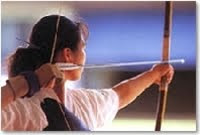
On the train tonight a lovely young woman sat in front of me who appeared to be a Zen archer; she was carrying the long bamboo bow, its full length carefully wrapped in a fabric traditionally dyed a splendid rare orange that bore other bright colors, like the bingata of Okinawa, in a pattern that was also traditional, of anciently stylized flowers, birds and butterflies, the bow reaching from the floor to well above the luggage rack.

Affixed to the bow by a wide leather wrapping was the lady's quiver of arrows, basically a capped tube about half the length of the bow. It too was a gorgeous object, finished in a grayish, elegantly patterned cloth and set with silver fittings. Circled at intervals with bands of smooth gray leather, it had a shiny brown hard-leather cap at the top, held in place by finely braided strips of gray leather.

Seated atop the leather cap was a figure I took at first to be a netsuke of an ancient god or something spiritually similar; I leaned closer for a better look, without being intrusive - this was Zen, after all - and saw that it was a tiny figure of Goofy, wearing baggy blue pants.

The arrow and the target are one.

Thursday, August 20, 2009


SLOW CHOW IN THE FAST LANE
or: You Put that on your Sushi?


If you’ve spent any time in Japan and so have tasted genuine traditionally brewed shoyu (soy sauce), there is no returning to the mockery that is LaChoy. Shoyu (and especially its earlier form, tamari) becomes an item and a subject dear to your heart.

For millennia, the Japanese have been making this sauce the traditional way, using the natural process of fermenting a blend of soybeans, water and koji for several months in specially made wooden vats to achieve the flavor peak-- the slow chow summit.

To make a wide story narrow: who has the time for that slow stuff anymore? Some entrefarceur came along and slapped together trainloads of hydrolyzed soy (or other!) protein, a few cargo containers of flavor enhancers and some tanktruckfuls of artificial coloring to make overnight what unknowing consumers in other countries call "soy sauce" (at which the Japanese laugh up their kimono sleeves, much as the French chuckle into their berets at Newark Camembert). Thus began the Shoyu Wars, which have been raging spicily for some time now. And things are not getting simpler.

Few have heard of an organization called the International Hydrolyzed Protein Council, which supplies the elemental falsehood (at least it’s the remnant of a protein) that goes into “soy sauce,” a non-brewed fingersnap containing caramel color, corn syrup, salt and hydrolyzed soy (or "other" (unnameable!)) protein. This brownish, salty, uncertain liquid is to genuine shoyu / tamari as kerosene is to Chardonnay. A difference reflecting the fact that some societies have time-honored traditions to maintain and are still sticklers for quality and considered action - native yearners for the real thing - whereas some societies (perhaps ultimately even Japan itself) don’t seem to have the time.

In any case, the IHPC has justified its position by observing that its soy swill sauce has been selling for decades now, and no consumers have complained. Perhaps there has been no complaint because they know no better, or maybe they are no longer living - who really knows - but the consumers anyway deserve the brush-off for buying such stuff with no questions asked, in the fastfood manner.

Not surprisingly, the Japanese want genuine soy sauce, made in the traditional way, to be the international standard, which is what anyone in his or her right mind would want, but the Right Mind category seems to exclude the folks who make the faux sauce and the folks at the IHPC, who supply the chemo that covers up the octane. They want the standard to read something like: “Soy sauce shall be defined as anything that has 'soy sauce' written on it." Big bucks there.

And a slap in the face to tradition, quality, care, nutrition, integrity and all that other useless baggage that just slows us down as we careen headlong through the Fast Century.

Saturday, January 03, 2009


SO DID YOU DREAM OF AN EGGPLANT OR WHAT?


Even better, you dreamed of a hawk; or if you had the best dream of all you dreamed of Mt. Fuji. No? Well at the very least, some tobacco or maybe a blind acupressurist?

According to the tradition of hatsuyume, the first dream you have in the new year is auspicious, and tradition covers some pret-ty weird corners of the old racial memory, as we all know. Probably the weirdest corners we all know. But tobacco or a blind acupressurist? Who could combine those things, let alone as sequentially auspicious, but tradition?

So here's to tradition for the new year. We could sure use more of it, by the look of the leftovers from last year. BTW, any traditionalists know if chocolate ice cream in a highly foreign country is anywhere on that list?

Thursday, December 11, 2008


BENTO RAD

Below is a link to a site showing photos of creative school lunch bento ideas for the season/month. Only in Japanese, unfortunately, but easy to navigate to see some of the rad-mad lunch/dessert design ideas for the once simple bento, posted since 2002...

On the page for November 2008 (years and months indexed at top of linked page), that is not my house in the woods, but it sure looks like one of my many marauding monkeys, likely looking for purloinable dainties to put in his bento.

To give you some further idea of how far the bento-as-art phenomenon has gone...

Thursday, October 23, 2008


CHAIRS


A time-darkened chair of oak, it stood among other chairs of other kinds, empty of all but time and craft, in a warehouse for antiques; a sign said the chair had been made in England a couple of hundred years ago. It was a spoked, round-back chair with arms, a practical chair, its seat a single slab of wood, selected with care that the beautiful grain would be polished to this very sheen by centuries of backsides, and it looked in the physical language inviting so I sat in it.

The chair had been made for the body the way only a lifelong maker of chairs for folks he will see every day for the rest of his life makes a chair. It wasn't a quick production line assembly for a never-known stranger somewhere else in the world; it was the hand-fashioned essence of chair, that the maker himself had been fashioning, by way of his family, for three or four hundred years or even more, until his fingers, hands and heart knew vastly more than just how to make chairs-- the feeling was born into the hands by then, and one man could conjure an entire chair, for the entire body, out of wood with just fire and iron, make it sing with function.

I could feel that song in my self when I leaned my back upon the back of the chair and lay my arms upon its arms, my hands coming to rest where hands had been anticipated with simple grace, the maker saying to me thus eloquently over centuries that he had known how and where my elbows and hands would come to rest, how they would want to rest and how to welcome them-- where hands had in fact been coming to rest for centuries-- are we not one, after all, for here was a chair that was made for the one we each are: not a market unit but a person, with whom a chair should be a private conversation.

It was a chair made to last beyond a life, like a poem or a song, the craft of it to be remembered, another form of the name of the maker, of himself and the grace of his hands to be passed on and spoken of, sung of in wood, taken good comfort in, and I realized I had in all my years on earth never been so well understood by a chair; no chair had ever told me of these things. Every chair I'd ever sat in had been mute, built for a phantom, a non-existent entity, an average consumer. Few go this far to make chairs any more; and if they do, the result is a remarkable not to say purely aesthetic artifact unique to its time and form, costing too much to be actually sat in, more design than chair and so not comfortable to the sitter, who feels less valuable than what he sits in, as though there were truth in a throne.

In my time I have sat in many chairs, that made me feel all sorts of ways-- from the tubular kind with the plastic caps on the leg-ends that chaired the 1950's to bags of styrofoam beads to leather/steel trapezoids on legs to straight-back chairs, bentwood chairs, easy chairs, reclining chairs, and on and on, and this was the first chair that had ever, how shall I say it, welcomed me, personally. The back curled round and the arms curled round and I was really in the chair, felt both embraced and rooted as I sat there, rooted like an ancient tree; there was no postural insistence from the chair, no disquieting tipsiness, no jittery ricketyness, no gangly angularity, no shoddy looseness, no shivery tubularity, no artistic misfitting, but solidity: simple, rooted, oaktree solidity, after 200 years of use!!!

What today is made like that? What today like that is made by a man who, like his father and grandfather and further back, has fashioned his very life into comfort for people he knows and will never know, from whom he seeks respect and appreciation, even centuries hence? Sitting in the chair I could feel in my heart as in my body every measure of the distance we have come from all the things that in their ways once filled life quietly and elegantly to the brim, how things in themselves used to tell us of one another, and show in their use the care that resided in what we crafted, how wholeheartedly we gave of our lives in our creations.

This was a chair that had been made by transforming the beauty of trees through the beauty of hands into the beauty of chairs. How far from there we are, on the chairs that bear us now, when we never set eyes on or even sense who makes the chairs we use, and more and more likely it's not even a who but a series of whats, as the spirit of hands fades from the products around us until there isn't a caress in a carload, and we live unknown by our surroundings is what the chair said, with an eloquence increasingly lost to our time.
[Rewritten from the archives]

Thursday, April 03, 2008


THE FLAVOR OF SHAPE


Now and then, like a butterfly on Mt. Everest, I've touched briefly on this subject in these crude musings, but I've never been quite able to fully grasp, any more than the butterfly the mountain, the fact that so much of Japan's taste delight is a matter of form.

In the West, form plays an important role in gourmet and lesser categories of dining - at this point I cannot help but visualize a forthright wedge of cherry pie with a stalwart scoop of Rocky Road by its side - but beneath the swirls of foody sauce and herbs and whatnot there is a rainbow, a bright rainbow, of flavor and savor is there not, a scrumptiousness, a lusciousness, an exquisiteness that begets deep ooohs and ahhhhs and mmmmms, so the merely visual aspect of Western food (consisting of something like "Boy, does that hot dog look good!") is ballpark maybe 10-15% of the overall experience wouldn't you say? Sorry to ask while your mouth is full...

Anyway, in Japanese cuisine it seems to me that the visual/taste ratio must at times be as much as 70-80%... Subtlety is the thing here, such subtlety as to at first be often indiscernible by the alien tongue, as for example when the newbie first tastes udon, or is dining with natives who are ecstasizing over the deliciousness of the plain white rice they're eagerly devouring, when to the newbie plain white rice has even less taste than white bread, though slightly more taste than air. Most Japanese simply LOVE white rice and cannot live without it. No matter how long I live here, though, I will never love white rice. I find it a pleasant, often essential accompaniment to a Japanese meal, but an accompaniment, not the star feature, nowhere near food hollywood.

This is all purely cultural of course, and as close as I'll ever get to straddling the gap where I had hoped there would one day be a bridge, but I just can't get my mind around the fact that, for example, someone in the office returns from a vacation trip to a locale famed for its, say, pagoda, and for family and office workers brings back treats in the shape of a -- pagoda, formed of rice or wheat flour baked in a mold and filled with white or brown sweet bean paste about the consistency of soft chalk, and everyone oohs and ahhs over the deliciousness of it, every time. True, it is tasty, mostly with curiosity, the first time or even the first two times...

Then another colleague comes back from a trip to another place, this one famed for its lanterns, or its birds, or its roof tiles, and brings back treats for everyone, created right there in the visited locale, made in the shape of
a -- lantern, a bird, or a roof tile, all laid out in a nice box for tasty travel souvenirs, all baked in a mold and filled with white or brown sweet bean paste as above, with a shelf life of about 10 years, and everyone oohs and ahhs over the deliciousness of it, every time.

But for me, long before the 150th time, a series of little mental bubble-clouds pop up, asking: do I like the taste of the shape of a bird better than the taste of the shape of a lantern? Can I taste the difference between shapes? What does shape taste like, anyway? Is it a Japanese taste? Can Americans taste shape if they live long enough in Japan? It seems not... Though it does my heart good to see Hello Kitty fried...

After hundreds of these food objects (I have a desk drawer full of these things, they make great paperweights),
I just don't get it. I always begin to wonder: isn't anybody asking for maybe a change? Maybe a little chocolate inside, or strawberry jam or, oh, anything? For a change? Hello? This isn't the first time I've asked.

I know I'm missing something here as the outsider, but no matter where I look, I just can't find it, because it's outside me, a guy who grew up with jelly (raspberry, strawberry etc.)/chocolate/cream donuts, as just one example, in a land like a cultural carnival where every foody souvenir is really different, and generally eaten on the spot, like the coconut creme pie at that little roadside restaurant in Vermont in 1971... I don't remember the taste of the shape, but I'll never forget the taste of the pie.

Photos via

Tuesday, December 25, 2007


Merry Geol!


Thursday, November 29, 2007


WHAT IS THE REST OF THE WORLD?


Speaking of hunting, I just read an article in the Japan Times-- to which I would link, but the paper's website contains only yesterday's issue, as dead trees continue to fall unheard in forests of electrons, so I'll just refer to the article and you'll have to trust me until the JT gets off its duff and onto the edge where news is and you can see their words instantaneously wherever in the world you are, though that will be yesterday compared to the nanopinpoint of the neonow-- anyway, where was I before I had to struggle against the undertow of ago?

Oh yes, speaking of hunting... Japan is going whale hunting again, maintaining its recent tradition while rejecting the ancient tradition argument put forth by the Ainu, who wish to hunt salmon in what is a genuine tradition (Genuine tradition requisite #42: "A genuine tradition cannot be made up by politicians.")

This fresh round of traditional whale killing, like the hidden dolphin slaughter of last week, will be in the face of world opposition, and this time will also include the explosive harpooning of humpback whales, there is such a craving among Japanese politicians for whale autopsy results. Mr. Splashy Pants will perhaps be among the slain (see post below).

In response to strong criticism from the rest of the world regarding the hunt, Joji Morishita, Director of what are not laughingly described as 'international negotiations,' says "When we hear that the rest of the world is against Japan, we say: 'Wait, wait. What is the rest of the world?'" Some folks still miss the Dark Ages.

Dinosaur hunting, anyone?


[Update: The Significance of Mr. Splashy Pants]

[Another update: Turns out this was my 3000th post!]


Friday, December 22, 2006


NAKED BREAKFAST


As implied in the previous post and the sake one a while before that, Japan is undergoing deep and profound changes, changes that will accelerate as the roots of tradition are perceived less like sources of ancient nourishment and more like stone anchors to a hydrogen lifestyle.

It was in that frame of transience that I gazed from the train window this morning while it was stopped at a small station up the line - this is out in the country, mind you, where the pace of change is factored somewhat by distance from the big city - and there beheld an attractive young woman seated alone on a bench on the platform, waiting for her train and scarfing a large and messy pastry.

When I say 'scarfing' I mean it in the Western sense-- the only sense there is, really. Japan has never really had a native form of scarfing, perhaps the closest thing being the always astonishing inhalation of searing-hot ramen noodles by truck drivers in a hurry to get back on the road, but that's more like econo-utility vacuuming than consumptive lust.

When I first came to Japan in 1972, nobody in Tokyo scarfed on the street but me, for a while, and maybe a couple other foreigners. After I'd been here quite a while and no longer scarfed in public I would occasionally be offended upon seeing some recently arrived foreigner walking down the street nakedly devouring food, right out there in the open, in plain view of all those offended natives walking by and standing around who were not eating in public and would never do so-- it was an egregious public offense and embarrassing to me, a foreigner who might thereby be lumped together with this lascivious consumer, this public masticator, this gustatorial miscreant.

But now, a mere 25 years later, there before my veteran eyes sat a stylish young Japanese woman (formerly the class of individual least likely to scarf even in private, let alone in public), right there out in the open - before an audience train packed with bored commuters - scarfing like there never had been any feminine delicacy toward public sensibilities in all this country's long and extremely polite history. I had a ringside window seat, so I enjoyed the show.

The pert young lady didn't scarf in a tentative, ladylike, experimental, culturally uncertain sampling sort of way: she went for the gold, she scarfed like a pro. The kind of scarfing I mean was best depicted - in my recent reference - in that superb movie The Commitments, in the scene where the loutish but golden-voiced lead singer is scarfing what looks like a generous potato salad sandwich on a large hot dog roll, practically jamming it into his mouth in consumptive eagerness, getting stuff all over his nose and face in the process, while the backup singers (the long dark-haired one is a special heart-throb) watch in disgust. So what was offensive even in formerly third-world Dublin was occurring - slightly more fastidiously, it should be noted for the record - right there on a Japanese countryside train platform in this very Heisei era.

Folks out there in the elsewheres of the world may not immediately perceive what this means. This is the end of Japan as it was once known! A stylish young woman, member of the social group that only yesterday was the eternal repository of Japanese decorum, was unself-consciously scarfing at the Olympic level in front of hundreds of non-eating, mostly male watchers-- unthinkable!

In terms of the changes it portends, imagine traditional Japan as a scrumptious pastry about to be jammed into a wide-open mouth...

Thursday, February 16, 2006


BEANS IN THE DEVIL'S EYE

On Friday night - which was Setsubun, the first day of the Lunar Spring - in keeping with an ancient Japanese tradition the visiting grandkids got the chance to shout "Out with the devil! In with good fortune!" at the top of their voices over and over while throwing handfuls of roasted soybeans out into the darkness from all the doorways of the house. It was interesting to see how they handled it.

A lot of folks are cynical about the rituals of tradition, especially ancient tradition, such as Setsubun is. Cynicism is one of the cheaper philosophies, requiring no real experience or thought (indeed, it is diminished by both). But anyone who has actually lived and perceptively experienced what is out in the world knows full well that there is value in traditional metaphoric/symbolic reminders of the ideal, and worth in speaking out for it.

There is uplift to ritual (the other side of science) as well, in thus asserting - as in Setsubun - that we have a measure of control over the presence or absence of "the devil" and over our own fortunes. It is of deep worth to remind ourselves of this and to teach our children that they too have individual power (not surrendered power, as to a political or religious organization) that can be personally brought to bear on behalf of goodness and bright fortune not only for themselves, but for their entire household and all its members, and by extension, society itself.

Setsubun is an anciently tacit – though noisy - erasure of animosities and a rebuke to the untoward. By flinging hard beans in the face of misfortune you are showing the night your strength, shouting out to the darkness without as well as within (the house and yourself) that you care about the entities that reside here, that you are responsible for and will defend this place, for this household and its members are shared in your charge.


Friday, October 17, 2003


HOW GOLDEN ARCHES GOT HIS NAME


He had fasted for many days as he wandered the prairie naked, far from his tribe, seeking the vision that would make him a shaman. But he had heard no voice, only the sky-wide sweep of the prairie grasses, shoulder-high, whispering the long word of the wind. Then one evening as he stood on a low hill overlooking a broad plain covered with buffalo as far as the eye could see, he suddenly was able to look further, and envisioned a great chain of hamburger stands, highlighting the shoulders of six-lane expressways through a great, rich city rising higher and higher into the sky where junior executives from renowned universities worked at keyboards in cubicles among the clouds from 9 to 5 above a howling metropolitan area surrounded by vast stockyards linked to key railway connections festooned with wire that led off to other great cities and international airports. He envisioned a Pontiac dealership with many perks, and returned at once to his tribe to share his vision with the elders, who when he told them could not stop laughing; for what could possibly be the value of such mad visions? He was definitely not shaman material, they concluded, and assigned him the task of picking berries with the old women, who tagged him with the nickname he bore till the end of his days.

Wednesday, January 15, 2003

DEVIL RUNNING

Drove over to Chojuji temple in Ishibe-cho in the mountains across the lake to see the oni bashiri (devil running), which I'd expected to be thronged and peppered with neck-craning tourists and diluted with that sense of urgency and unrealness that tourists impart, but there were only locals there, mostly grandparents and their grandchildren, the new parents apparently not so interested in passing on to their children what is about to be lost, the parents themselves maybe never having embraced it enough to value, so it was all the more poignant to see this time-alloyed excitement of the aging soul, this modern-age pointing out by the elders to the exceedingly young the basic truths of life as manifested in devils and masks, ritual and chant, bell and drum, fear and redemption.

It was a small building as temples go, built near a thousand years ago and roofed in cedar bark, far off to one side of the main highway artery, close to the heart of things. All the doors were closed, and after the cradling lull of the sacred chant, when the drums began to boom and the bells to clang, the heart and the blood did the same, no matter what one's religion; for truth has little to do with religion, it has to do with blood and bone, eyes and time, rhythm and memory in those rising through an entire life on the cusp of now; both the future and the past were there in great measure, devilish and otherwise, with respect, awe, humor, and a touch of practiced disdain from the teenage oni with their bleached hair, who nevertheless did their best and it was none too bad, clearly they had dallied with deviltry before; but it was a revelation to see it all without a mass of tourists, it was like another country, so simple still, so pure, as to give me some hope for the ancient heart of Japan, that it may yet beat into the coming century, when some new hearts will take it up and make it their own, and that what is good about devils will go on.